Personal perception of the 2025 august wildfire in the Corbières (Aude/Mediterranean France)

The images of the Corbières wildfire motivated me to publish a slightly revised version of my text on my ‚paysages‘ blog, which I sent to Bloomberg journalist Joe Wertz (see below in Italic). He had asked me some questions about the current wildfire situation in Mediterranean regions at the beginning of July 2025. I don’t know if part of my little text has entered in any journalistic publication. But I think what I wrote down in the first days of July, has not lost any of their relevance, quite the contrary. The Corbières‘ wildfire – or “L’incendie du massif des Corbières de 2025” – how the fire is called in French is the second largest wild fire in France since 1949. The largest and deadliest forest fire in France was the 1949 Landes forest fire, in which 50,000 hectares (500 km2) of forest land were burnt[1] – and 82 people killed. In the Corbières currently (08.08.2025), about 17.000 ha of forest & garrigues bushlands were consumed by flames.

I know the region very well, having conducted fieldwork there over many years and taught university students about Mediterranean field and fire ecology[2]. I have also participated in prescribed fire training in this area with some of my students[3]. Additionally, I have family connections in this region, specifically in Leucate on the Mediterranean coastline of the Corbières, which is also known as ‚les Corbières maritimes[4] .

My personal perception is that approximately half of the landscape surface of the Corbières maritimes has been burned. This wildfire, like many others in the Mediterranean, is the consequence of long-term rural abandonment, bush encroachment, and “wild” suburban sprawl what is often referred to as ‚Californisation‚ in francophone geography[5]  . In recent years, climate change has exacerbated fire risks in these high-fuel-load landscapes. As in the area between Cap Leucate and the Spanish border (Ringeisen 2024), the Corbières Maritimes have been exposed to an ongoing drought and several repeated heat waves in recent years. Even though I haven’t calculated any „climate impact models“ for the Corbières myself, I would say that after more than 30 years of fieldwork in this area, ongoing climate change is leaving its mark on the landscapes of the Corbières and many other regions around the old-world Mediterranean basin—the „Mare Nostrum“ of Roman geography.

Of course, there is no single cause explanation for wildfire risks in Mediterranean landscapes. But it seems certain that climate change is worsening the situation.

For many years, I have warned about this dramatic evolution in Mediterranean landscapes through scientific publications, press interviews, and texts in my ‚paysages‘ blog[6]. However, my words seemed to have been carried away by the wind—or, to name a local storm, the Tramontane has blown all these warnings into the Gulf of Lion. But this does not only concern my personal warnings; all the warnings from scientists around the world about increasing wildfire risks and climate change seem to fade away unheard in an ocean of silence.

Of course, nature will recover; blooming flowers will emerge from the ashes in the Corbières. However, for the people living in these burnt areas, restarting their lives will be very difficult. A forest fire that has burned about 17,000 hectares of landscape also completely changes the human geography of the affected land. Will people return to the partly burnt villages? What will the „néoruraux“ do?

Scientists researching forest or wildfires often focus on „vegetation recovery“ or the impact of fires on ecosystem services. However, in Europe, people live in these burnt areas, and for them, such a fire event is a catastrophe, upending their entire lives—as is currently the case in the fire area of the Corbières Maritimes, known as „L’incendie du massif des Corbières de 2025.“

Below, in italics, is the text written at the beginning of July for journalist Joe Wertz. It was slightly revised on August 8, 2025, to include information about the August 2025 wildfire in the Corbières

Mediterranean France, and Italy), Western Europe (UK, non-Mediterranean France, Belgium), and Central Europe (Germany, Switzerland, and Austria). In Mediterranean regions, recent fires, such as the incendies de Narbonne – Bages – Sigean on July 7, 2025, where the motorway A9 to Spain was interrupted due to the fires, indicate that we will face more violent and intense fires. Additionally, the ‚Californisation‘ of suburbs will increase wildfire hazards, as demonstrated by the recent fires in Marseille-Pennes-Mirabeau on July 8, 2025. In this incident, entire residential areas were burnt down, and the Marseille- Provence International Airport had to be shut down. The French fire department, arguably the best-equipped and trained in Europe for fighting forest fires, was significantly challenged by the simultaneous occurrence of these two fires. The simultaneous occurrence of intensive and very dangerous forest fires will become a common scenario in Western Mediterranean countries due to climate change. The aggressive wildfires in the Corbières in August 2025 demonstrated that these intense fires stretched the French fire brigade to their operational limits, utilizing 9 of the 12 Canadair CL-415 firefighting aircraft available in France.

Moreover, we will also witness more large and deadly forest fires, similar to the historical Landes Forest Fires in 1949 (which killed 82 people) or the historical fire on the Lüneburg Heath in 1975. Climate change will not only affect wildfire dynamics in Mediterranean ecosystems but also transform many regions in Europe into wildfire risk landscapes, even in french brittany and some larger parts of the UK – as recently the wildfire in the Forêt de Brocéliande (17.07.2025) shows.

Bibliography and Further Reading

This bibliography includes my own works, as well as those of my colleagues—some of which are still written in French—and encompasses ‚grey literature.‘ However, to gain a deep understanding of landscape dynamics, one must also speak (and read) the language of the people inhabiting that landscape. In the Corbières, that language is French. I will try to add more references over time.

Curt, Thomas, Frejaville, Thibaut (2017) : Wildfire Policy in Mediterranean France: How Far is it Efficient and Sustainable? July 2017, Risk Analysis 38(11), DOI: 10.1111/risa.12855

Curt, Thomas & Rigolot, Eric (2020) :  Prévenir les risques d’incendies de forêt dans un contexte de changement global.    Sciences Eaux & Territoires Numéro 33(3), DOI: 10.3917/set.033.0050

Curt, Thomas; Helly, Christelle; Barbero, Renaud; Dupuy, Jean-Luc; Mouillot, Florent; Raufault, Julien (Eds)(2022) : Feux de Végétation. : comprendre leur diversité et leur évolution. Versailles, 2022         © éditions Quæ, 2022 Versailles, ISBN 978-2-7592-3507-0

Garrone, B. (2004) : Le feu dans la nature mythes et réalité. Prades -le- Lez (Les Ecologistes de l‘ Euzière). ISBN 2-906128-17-1.

Neff, Christophe (2003) : Les Corbières maritimes – forment-elles un étage de végétation méditerranéenne thermophile masqué par la pression humaine?. The mediterranean world – environment and history. Ed.: É. Fouache, 191–202, Elsevier.

Ringeisen, Laura (2024): Signs of Climate Change in the Mediterranean Area in Southwestern France between Cap Leucate and Cap Béar. Master’s Thesis in Geography (Supervisors: Dr. Christophe Neff/Prof. Almut Arneth, IFGG, KIT). Karlsruhe Institute of Technology (KIT), DOI: 10.5445/IR/1000184793 .

Christophe Neff, Grünstadt 08 of August 2025


[1] See also „The Fatal Forest Fire – remembering the “1949 Mega fire” in the „Forêt des Landes” (South West France)”.

[2] See « Blognotice 16.06.2022: Retour à Leucate – des vagues de la méditerranée qui se brisent au Cap Leucate jusques aux neiges du massif du Carlit – récit d’un cours de géobotanique en juin 2022 ».

[3] See „Chantiers de brûlage dirige – KIT – Facebook Media Album, 22. Februar 2011

[4] See « Blognotice 7.08.2013: Les cigales de Port Leucate ».

[5] See Neff & Baum 2012, „The Social Ecology of Californisation & Littoralisation in Mediterranean France,“ oral contribution at the 32nd International Geographical Congress (IGC 2012), Köln, Germany, 26.08.2012 – 30.08.2012. The presentation is available at KITopen, DOI: 10.5445/IR/1000149710.

[6] See « Feux de forêts et lectures de paysages méditerranéens: (Écologie et biogéographie des forêts du bassin méditerranéen ; The Nature of Mediterranean Europe – an Ecological History ; Le feu dans la nature – mythes et réalité) » – and also for example « Blognotice 01.05.2017: « Les fleurs qui poussent à travers les rails de la France périphérique » or « Pyrotragedies – a critical retrospective on the wildfire situation in Europe during July 2018 ».
Blognotice “27.10.2024” :  America where are you going ?

Good morning, America, how are you?
Say, don’t you know me? I’m your native son.
I’m the train they call the City of New Orleans
.”  (City of New Orleans, Steve Goodman)[1]

During my university years I was also singing a little bit in bar & cafés – and the “City of New Orleans” belonged to my singing repertoire with other songs, mostly French chansons which I used to sing in bars & cafés in Mannheim and in my hometown Schramberg[2]. Singing those songs, – was also a sort of dreaming of the American landscapes. But still I have never been in the United States of America!

I am belonging to a generation for which the USA are still the land of Liberty. In German we often call the USA “das Land der unbegrenzten Möglichkeiten” – “the  land of unlimited possibilities”. So sometimes I think, – that after retirement, if America is still a liberal democracy I will try to visit the US, and travelling around there by train. But will the US still be the land of freedom and liberty? Observing the presidential elections of 2024 I have some doubts. I hope Kamela Harris will win the election, but I fear Donald Trump could win this 2024 presidential race. In 2016 I was one of the rare persons forecasting in some way the victory of Donald Trump[3]. Now it seems that it will be a head-to-head race. A victory of Donald Trump would be a disaster for freedom and liberty of the whole planet earth. The Ukraine would also be put into a very difficult situation by a new Presidency of Donald Trump[4]. Imagining Trump turning the USA, the land of freedom, into an authoritarian state is a nightmare. In some way the 6 January 2021 was a pretaste of that nightmare[5] !

But I think currently Kamela Harris has still a chance to win this fateful presidential election. If she wins, and I hope she will win, I will try to travel through the US by train, after my retirement in some years! But currently as an attentive observer of the us political landscape, I can only wait until the 5 of November, – and sometimes share texts and videos etc. on #Mastodon for Harris Walz – as I did with the video message from Timothy SnyderObeying in advance Media billionaires ask for tyranny” and other messages I shared.

Closing my eyes, singing the City of New Orleans, – imaging me riding on a train through the US, – the City of New Orleansthe Adirondack, California Zephyr,  Coast Starlight and other trains…,  remembering “Amtrak Joe”, – the nick name of Joe Biden[6]. Never forget his courageous decision to withdraw his candidacy for presidential election in July 2024. So he levelled the way for the Kamela Harris & Tim Walz candidacy.

I have a schoolmate living in a town in the West US, which has an Amtrak Station served by the California Zephyr. Perhaps I would make a stop there, – to visit her and her family. 40 years ago we took our Abitur together in the Gymnasium Schramberg in the Black Forest town of Schramberg. She has become an American Citizen and has publicly endorsed for Kamala Harris on Facebook. I have had other schoolmates living in the USA, – but for different reasons they all come back to “old Europe”. Perhaps one day I should ask them, why they left the US and come back to Europe? Geography, family, distance, new love, new job – or other reasons ?

40 years ago, as a high school student in the Gymnasium Schramberg, I could never have imagined that the USA – the land of freedom – the land of unlimited possibilities – would turn into a proto-fascist authoritarian state! That would probably happen if Trump wins the presidential election on Tuesday, November 5, 2024!

America where are you going  ?

Good morning, America, how are you?
Say, don’t you know me? I’m your native son.
I’m the train they call the City of New Orleans
.” (City of New Orleans, Steve Goodman)

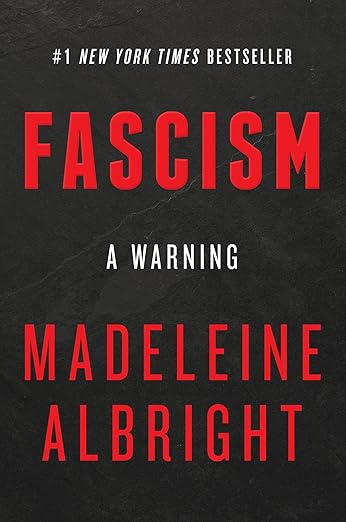
Ilustration: Book Cover of Albright, Madeleine; Woodward, Bill (2018): Fascism a warning (with Bill Woodward). London, 2018. ISBN 978-0-00-828227-1 which I also used in the post “Witnessed from Grünstadt: The storm of the United States Capitol on Epiphany 2021

Christophe Neff, Grünstadt 27.10.2024


[1] Here you can find a link to a youtube version (Arlo Guthrie interpretation) including lyrics of the City of New Orleans!  

[2] See also „Mannemer Dreck- traumhafte Zeiten – eine autobiographische Zeitreise mit Musikbegleitung nach Mannheim (in German)

[3] See also „Blognotice 02.11.2020: Donald Trump peut – il encore gagner ? and « Rétrospectives sur le blog paysages en 2016 – les billets les plus lus de « paysages » en 2016 ». The second post includes a screenshot of my Facebookpost of the 05.11.2016 in which i predicted the victory of Donald Trump.

[4] See also “L’année 2023 sur le blog paysages – une rétrospective/eine Rückschau auf das Jahr 2023 im Paysagesblog” and „Blognotice 18.08.2024: de retour à Grünstadt – et les martinets se sont déjà envolés vers le Sud„.

[5] See also „Witnessed from Grünstadt: The storm of the United States Capitol on Epiphany 2021

[6] See also “„Where Did „Amtrak Joe,“ Joe Biden’s Nickname, Come From? What may be Joe Biden’s most enduring nickname, Amtrak Joe, began out of family tragedy and morphed into a lifelong support of the railway” . Marie Clarie, May 2020

Blognotice 26.03.2022: Vue sur la crise sismovolcanique de São Jorge/ View on the seismovolcanic crisis of São Jorge

Capture d’écran/Screenshot de l’ Instituto de Investigação em Vulcanologia e Avaliação de Riscos  –  Crise Sismovulcânica de São Jorge,  Activités sismiques sur Sao Jorge 26.03.2022,
© Instituto de Investigação em Vulcanologia e Avaliação de Riscos, Centro de Informação e Vigilância Sismovulcânica dos Açores

Au milieu de l’Atlantique sur la petite île de São Jorge de l’archipel des Açores une crise sismovolcanique (Crise Sismovulcânica de São Jorge en portugais) est actuellement en cours. Je suis cette crise depuis Grünstadt sur les pages web  de l’ Instituto de Investigação em Vulcanologia e Avaliação de Riscos du gouvernement des Açores. Il y une page dénommée « Crise Sismovulcânica de São Jorge » avec une carte qui montre l’activité sismique sur île de São Jorge.  Le niveau d’alarme à l’heure où j’écris ces lignes est à V4. Cela veut dire que d’après l’échelle d’alarme en vigueur sur l’archipel des Açores on se situe en phase prééruptive volcanique[1].  Je ne suis ni géologue, ni vulcanologue, – mais un simple géographe-géobotaniste de terrain, mais je pense que la probabilité d’une éruption volcanique sur l’île de São Jorge semble actuellement très élevée. Géographe-géobotaniste, que je suis, je fais des recherches géobotaniques depuis plus de vingt ans sur une des îles voisines à peine une vingtaine de kilomètre de vols d’oiseaux de São Jorge sur l’île de Faial. J’étudie la végétation pionnière sur le volcan du Capelinhos, la dynamique végétale sur champs de cendres de Capelo[2]. Le Capelinhos est ce volcan, qui sortit des vagues de l’atlantique en Septembre 1957, à quelques centaines de mètres devant la partie occidentale de île de Faial. La dernière éruption sur ile de  São Jorge fut l’éruption du « Vulcão da Urzelina » en 1808. Donc 214 années après cette dernière éruption volcanique sur l’ile de São Jorge on pourrait voire réapparaitre des coulées de laves à São Jorge. D’ailleurs São Jorge est une des rares îles des Açores  que je ne connais pas. Je n’y ai jamais mis le pied. C’est aussi, d’après mes infos le seul endroit en Europe où on trouve des plantations de Café. J’espère que les autorités açoriennes ont pris toutes les mesures nécessaires pour protéger la population de São Jorge !

In the middle of the Atlantic Ocean on the small island of São Jorge in the Azores archipelago a seismovolcanic crisis (Crise Sismovulcânica de São Jorge in Portuguese) is currently underway. I follow this crisis from Grünstadt on the web pages of the Instituto de Investigação em Vulcanologia e Avaliação de Riscos of the government of the Azores. There is a page called „Crise Sismovulcânica de São Jorge“ with a map that shows the seismic activity  on the island of São Jorge.  The alarm level at the time of writing is V4. This means that according to the alarm scale in force in the Azores archipelago we are in the pre-eruptive volcanic phase[3].  I am not a geologist, nor a vulcanologist, but simply a geographer & fieldbotanist, but I think that the probability of a volcanic eruption on the island of São Jorge seems to be very high. As a fieldecologist, I have been doing geobotanical research for more than twenty years on one of the neighboring islands, only twenty kilometers from São Jorge on the island of Faial. I study the pioneer vegetation on the volcano of Capelinhos, the vegetation dynamics on ash fields of Capelo[4] . The Capelinhos is the volcano, which emerged from the Atlantic waves in September 1957, a few hundred meters in front of the western part of Faial island. The last eruption on the island of São Jorge was the eruption of “Vulcão da Urzelina” in 1808. So 214 years after this last volcanic eruption on the island of São Jorge we could see lava flows reappear in São Jorge. By the way, São Jorge is one of the few islands of the Azores that I don’t know. I have never set foot there. According to my information, it is the only place in Europe where you can find coffee plantations. I hope that the Azorean authorities have taken all the necessary measures to protect the population of São Jorge!

Capture d’écran/Screenshot de l’ Instituto de Investigação em Vulcanologia e Avaliação de Riscos  –  Crise Sismovulcânica de São Jorge,  Activités sismiques sur Sao Jorge 26.03.2022

Christophe Neff,  Grünstadt 26.03.2022


[1] Voir ici (en portugais) : Escala de alertas cientificos a carcaterizacao do estado de actividade sismovulcanica na regiao dos Açores.

[2] Voir: Neff, C. : Observations de la dynamique végétale sur le Volcan des Capelinhos (Île de Faial, Açores, Portugal). Finisterra, 56(117), pp.107- 126 . doi.org/10.18055/Finis18523

[3] See (in Portugese) : Escala de alertas cientificos a carcaterizacao do estado de actividade sismovulcanica na regiao dos Açores.

[4] See: Neff, C. : Observations de la dynamique végétale sur le Volcan des Capelinhos (Île de Faial, Açores, Portugal). Finisterra, 56(117), pp.107- 126 . doi.org/10.18055/Finis18523

Paysages – douzième année d’existence sur la toile donc déjà deux ans sur wordpress.com (billet trilingues français, allemand, anglais)

Paysages qui a débuté en mai 2009 comme blog abonné le Monde avec l’article « I. Un blog sur les paysages : un petit début – ou quelle langue choisir ? » entre dans sa douzième année d’existence. Durant le printemps 2019 le Monde annonce à ses abonnées bloggeur – que les blogs abonnés seraient supprimés début juin 2019et après avoir publié un dernier billet d’adieu retracant un peu l’épopée de paysages sur le monde.fr – paysages est relancé le 16 juin 2019 sur wordpress.com avec le billet « Nouveau départ pour le blog paysages ». Le transfert du Monde sur la plateforme et l’hébergeur wordpress.com s’est fait assez facilement mais début juillet 2019 un bug informatique a laissé disparaitre une grande quantité d’images et de liens – et jusqu’à présent je n’ai pas réussi à restaurer tous les images et liens de paysages. Dans les deux tableaux suivant je publie donc la liste des 10 articles les plus consultés depuis le 16 juin 2019 (jusque au 16.06.2021), date de la « relance » de paysages sur wordpress.com – et la liste des origines géographiques des consultations. Avec le passage sur wordpress.com paysages a perdu à peu près 2/3 de son lectorat – et surtout ces lecteurs proviennent maintenant majoritairement de pays non francophone ! Durant les années le Monde.fr paysages était un blog francophone, – et la plupart des lecteurs était des lecteurs franco-français ou provenait des pays francophones !

Ceci se traduit aussi dans la liste des dix articles les plus consultés depuis juin 2019, – 5 articles écrits en français, 3 en allemand, 2 en anglais. Néanmoins comme déjà durant les années le Monde.fr c’est l’article « 1949 – l‘incendie meurtrier dans la Forêt des Landes » décrivant l’incendie meurtrière de 1949 qui avait ravagé la forêt de landes en 1949, – feux de forêt qu’on pourrait d’ailleurs aussi caractériser comme une des rares «megafire/Mégafeu» du vingtième siècle en Europe car il respecte largement les critères des mégafeux avec ses 50.000 ha de pinedes & landes devorées  par les flammes et ses 82 morts, arrive en tête de ce petit classement des articles consultés sur paysages! On pourrait aussi ajouter que quatre des dix articles de ce classement concernant des billets traitant les incendies de forêts, l’embroussaillement du paysage et californisation des paysages!

Concernant le Monde, je ne cache pas que, que les déceptions n’ont malheureusement pas cessé après l’abandon des blogs abonnées, – le Monde vient de supprimer la version pdf du quotidien papier pour ses abonnées durant le printemps 2021 ! Encore une énième déception avec le journal le Monde – qui prétend être le journal de référence français et francophone, – j’ai d’ailleurs récemment consacré un billet « Encore une déception avec le Monde – La suppression du format PDF du journal numérique du Monde » à ce triste évènement !

Vue l’importance des lecteurs allemands (et anglophones) – suivent ici en dessous les traductions allemandes (et anglaises)!

RangTitre/Titel/titel%
11949 – l‘incendie meurtrier dans la Forêt des Landes3,64
2La fin annoncée des blogs abonnées du Monde.fr, la fin du blog paysages sur les blogs leMonde.fr3,06
3Souvenirs de vingt ans de voyage de recherche à Capelo (Île de Faial/Açores)2,66
4Erinnerungen an die „märklinModerne“2,33
5Blognotiz 18.4.2012: Kommentar zu Dirk Kurbjuweit „Die Freiheit der Wölfe – Wird das Internet zu einer neuen Schule der Barbarei?“2,15
6The Fatal Forest Fire – remembering the “1949 Mega fire” in the „Forêt des Landes” (South West France)1,64
7Pyrotragedies – a critical retrospective on the wildfire situation in Europe during July 20181,47
8Ein paar Tage im November 1989: Erinnerung zum Mauerfall aus Südwestdeutschland1,19
9De la neige entre Jendouba, Aïn Draham et Tabarka1,18
10La Forêt progresse à Schramberg – et les risques d‘ incendies aussi1,14

 Tableau 1.  Les dix articles les plus consultés de paysages du 16 juin 2019 au 16 juin 2021.

Paysages, welches im Mai 2009  als Abonnentenblog von der Tageszeitung „Le Monde“ mit dem Artikel „I. Un blog sur les paysages : un petit début – ou quelle langue choisir ?“ startete, beginnt nun das zwölfte Jahr seiner Präsenz im WWW. Im Frühjahr 2019 kündigte le Monde seinen Abonnentenblogger an, dass die Abonnenten Blogs Anfang Juni 2019 aufgegeben werden würdenund nachdem ein letzter Abschiedspost auf le monde.fr die Geschichte von paysages ein wenig nachzeichnete, wurde paysages am 16. Juni 2019 auf wordpress.com mit dem Post “ Nouveau départ pour le blog paysages“ neu gestartet. Der Transfer von Le Monde auf die Plattform und den Hoster wordpress.com verlief relativ problemlos, aber Anfang Juli 2019 ließ ein Bug eine große Menge an Bildern und Links verschwinden – und bis jetzt habe ich es nicht geschafft, alle Bilder und Links von paysages wiederherzustellen. In den beiden Tabellen veröffentliche ich daher die Liste der 10 meistgesehenen Artikel seit dem 16. Juni 2019 (bis zum 16.06.2021), dem Datum des „Relaunches“ von paysages auf wordpress.com – und die Liste der geografischen Herkunft der Aufrufe. Mit dem Umzug auf wordpress.com hat paysages etwa 2/3 seiner Leserschaft verloren – und was noch wichtiger ist, diese Leser kommen nun überwiegend aus nicht französischsprachigen Ländern! Während der Jahre auf le Monde.fr war paysages ein meist in Französisch verfasster Blog, – und die meisten Leser kamen aus Frankreich oder aus der frankophonen Welt!

Dies spiegelt sich auch in der Liste der zehn am häufigsten konsultierten Artikel seit Juni 2019 wider – 5 Artikel in französischer, 3 in deutscher und 2 in englischer Sprache. Doch wie schon in den Jahren als Abonnentenblog der Tageszeitung le Monde ist es der Artikel „1949 – l’incendie meurtrier dans la Forêt des Landes“ der dieses kleine- Klassement anführt. Der Artikel beschreibt den Waldbrand in der Forêt des Landes von 1949 , – einen Waldbrand, den man auch als einen der seltenen europäischen „Megafire/Megafeuer“ des zwanzigsten Jahrhunderts könnte. Mit den 50.000 ha Kiefernwälder & Heidelandschaft die in Flammen aufgingen und den 82 Todesopfern erfüllt dieser historische Waldbrand die Kriterien von Megafeuern bei weitem. Man könnte auch hinzufügen, dass vier der zehn Artikel in diesem Ranking Beiträge sind, die sich mit Waldbränden, Landschaftsverbuschung und Californisierungstendenzen beschäftigen!

Was Le Monde betrifft, ist es leider so, dass die Enttäuschungen auch nach der Einstellung der „Abonnentenblogs“ nicht aufgehört haben, – Le Monde hat gerade im Frühjahr 2021 die pdf-Version der Papierausgabe der Tageszeitung für seine Abonnenten abgeschafft! Eine weitere Enttäuschung mit der Tageszeitung le Monde – die für sich in Anspruch nimmt, die französische und frankophone Referenzzeitung zu sein, – diesem traurigen Ereignis habe ich kürzlich diesen Beitrag „Encore une déception avec le Monde – La suppression du format PDF du journal numérique du Monde  “ gewidmet!

RangsPays/Land/state%
1Allemagne/Deutschland/Germany54,55
2France/Frankreich20,87
3États-Unis d’Amérique/ USA11,13
4Tunisie1,20
5Suisse/Schweiz1,13
6Chine/China1,02
7Canada1,01
8Belgique1,01
9Corée du Sud/South-Corea/Südkorea0,79
10Portugal0,69

Tableau 2 : Liste des origines géographiques des lecteurs de paysages du 16 juin 2019 au 16 juin 2021

Paysages which started in May 2009 as a ”Le Monde” subscriberblog  with the article“« I. Un blog sur les paysages : un petit début – ou quelle langue choisir “ is entering its twelfth year of existence. During the spring of 2019 le Monde announces to its subscriber bloggers – that the subscribed blogs (blog abonnées le Monde.fr)  will be deleted at the beginning of June 2019and after having published a last farewell post retracing a bit the epic of “paysages” on le monde.fr – paysages is relaunched on June 16, 2019 on wordpress.com with the post „Nouveau départ pour le blog paysages „. The transfer from Le Monde to the wordpress.com host was quite easy but in the beginning of July 2019 a bug let disappear a large amount of images and links – and so far I have not managed to restore all the images and links of paysages which disappeared during this bug. In the following two tables I therefore publish the list of the 10 most viewed articles since June 16, 2019, (until 16.06.2021) the date of the „relaunch“ of paysages on wordpress.com – and the list of geographical origins of the views. With the move to wordpress.com paysages has lost about 2/3 of its readership – and especially these readers now come mostly from non-French speaking countries! During the years le Monde.fr paysages was a french blog, – and most of the readers came from France and the francophone world!

This is also reflected in the list of the ten most consulted articles since June 2019, – 5 articles written in French, 3 in German, 2 in English. Nevertheless as already during the years le Monde.fr it is the article „1949 – l’incendie meurtrier dans la Forêt des Landesdescribing the deadly fire of 1949 which had ravaged the forest of Landes in 1949, – forest fire which could be also characterized as one of the rare european „megafire“ of the twentieth century because it largely respects the criteria of megafires with its 50. 000 ha of pines & heathlands devoured by the flames and its 82 deaths, arrives at the head of this small classification of the articles consulted on paysages! One could also add that four of the ten articles in this ranking concern posts dealing with forest fires, bush encroachment and  californization of the landscape!

Concerning Le Monde, I don’t hide the fact that, unfortunately, the disappointments didn’t stop after the abandonment of the subscribed blogs, – Le Monde has just removed the pdf version of the daily paper for its subscribers during spring 2021! Yet another disappointment with the newspaper le Monde – which claims to be the French and francophone reference newspaper, – I have recently dedicated a post „Encore une déception avec le Monde – La suppression du format PDF du journal numérique du Monde“ to this sad event!

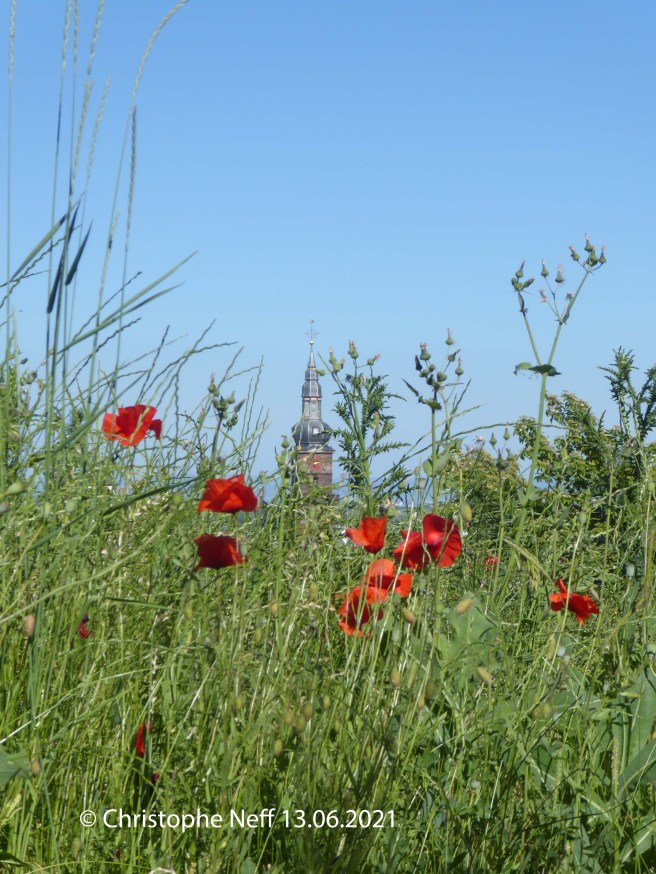
Photo : © Christophe Neff 13.06.2022, Vue sur le clocher de l’eglise St. Martin à Grünstadt à travers les Coquelicots !

Christophe Neff, Grünstadt 27.06.2021

Pyrotragedies – a critical retrospective on the wildfire situation in Europe during July 2018

July 2018 was the month in which Europe was heavily affected by wildfire events. There where forest fires in Sweden, in Greece and even in Germany there was one major forest fire event in July 2018.  A Scots Pine Forest near Fichtenwalde was heavily affected by a fire[1], thus remembering German authorities that Germany can also  be concerned by forest fires, – and recalling the terrible souvenirs of the Forest fires of the Lüneburger Heide in summer 1975. But it was Greece which was so heavily hit by several fire events, –the 2018 Attica wildfires – the city of Mati had to face a real “pyrotragedy” to use the words of Paulo Fernandes a portugese wild fire researcher[2]. Mati has been more or less completely erased by the wildfires, a landscape of ruins and desolation and a very high dead toll – about 88 people were killed by the fires in Mati[3]. For me the pictures of the landscape of ruins of Mati called up the souvenirs of the terrible fire event of  Pedrógão Grande[4] in Portugal last year.

Working on forest fires since the beginning of my academic career in 1992, I have been one of those scientists, who are continuously warning that climate change will also increase forest fire risks[5],[6]. But I also warn, since the beginning 1990’s, when I was mapping wild fire risks in the “Garrigues de  Nîmes”[7] under the guidance of Louis Trabaud[8], Peter Frankenberg and Rainer Joha Bender[9] that californisation & rural abandonment & bushencroachment are making the coming generation of forest fires so dangerous.

Californisation[10]  is the “terminus technicus” used in francophone geography, spatial planning and forestry for urban sprawl, housing, urban – forest interface, urban wild – interface etc. But I think the difference between the different English terms is that californisation also designs  the intermix of housing and extremely high inflammable forest (or bushformations like Garrigues, Maquis, Matoral, Chaparal etc. ) and high fuel loading[11].

However what term you use, I prefer californisation, because I think it describes the landscape scenery we can see in many Mediterranean regions of the world perfectly. People want to live like “Californians” constructing their house into a “green scenery” of forests & parks, like in Santa Barbara in California. In fire prone ecosystems, and all Mediterranean ecosystems are fire prone ecosystems, housing in such scenery is just like living on “powder – keg”. A forest fire occurring in this environment is a deadly trap for people, – and this exactly happened in Mati[12]. And what happened in Mati can happen in the suburbs of Lisbon, in the suburbs of Barcelona, Nîmes, Montpellier, Marseille, in La Marsa near Tunis ,- or in California or in Australia (even in the Mediterranean part of Chile and in the Cap region in South Africa). Working since the beginning of the 1990 in western European Mediterranean basin, I known so many locations in this area, where catastrophes like these which devasted Mati in Greece could also happen.

The combination of the consequences of climate change with the cocktail of californisation & rural abandonment will provide us more deadly fires in the Mediterranean regions of Europe (and perhaps also in Central Europe, Scandinavia etc.) – and I think society should react and force the governments to adapt their spatial planning to this enforced risk to see deadly forest fires spread up in that environment, to avoid situations that can lead to such fatal forest fires scenarios as the 1949 Landes Forest Fire which was the most deadly single fire which ever happened in Europe[13]. Concerning the 2018 Attica wildfires, this was a run of different fires, according to informations I could get about the fire.

What happened in Greece in the Attica region in July 2018, what happened in Pedrógão Grande in June 2017, but also in October 2017 in Portugal, these are (or were) real “pyrotragedies” and I hope that the fire season, which is going on until the End of October (in European Mediterranean regions) will not provide us other “pyrotragedies” in the Mediterranean (or elsewhere).

But the real question is if the governments in Greece or in Portugal will learn something from these “pyrotragedies”? The 1949 Landes Forest Fire with is high dead toll of 82 people killed by the fire, – provide a real shock in France – and after this shock France has made an enormous effort of systematic planning and construction of system of “Defending Forest against Wildfire” – “Défense de la forêt contre les incendies (DFCI)[14]” – which is now considered being one of the most effective “Anti Forest Fire Defence System” of the world. Perhaps someone should write down the history of the establishment of the French anti forest fire defense system, – as I know this has never been done – because this was not only success story, but the French responsible were able to learn from their different “failures”[15]– and that is very important.

In this context also associations, like the “Forêt Méditerranéenne”, have a very important role, – just remembering all the conferences dedicated to “fire prevention & wild fire management” and also all the articles dealing with forest fire published in the revue  “Forêt Méditerranéenne”[16]. Articles published in this revue are read by the people working in the forests, – the technicians, the forest engineer in direct contact, at the “frontline” with the “wildfires”. But even this relatively effective system of forest fire management, which has been established in France, is now challenged by “climate change” as recently Thomas Curt and Thibaut Frejaville showed in a study about “Wildfire Policy in Mediterranean France”[17].

My personal opinion is that science and research cannot alone provide the solution, at least perhaps applied geography and spatial planning, because it is a societal problem – how do we deal with californisation (urban sprawl, forest & urban interface, whatever you call it) in a highly inflammable environment – environment which also has a notable charge of fuel loading.  How can we manage this highly inflammable environment including climate change processes. It seems to be very difficult to find consistent solutions for that mix of problems. I personally, after working more or less since the beginning 1990s with forest fire risks, I have not “the solution”- but at least we should be honest to people living in this environment, to tell them, that they are living on a “powder – keg”. If there are no evacuation plans (and evacuation has to be trained), if fire brigades are not well trained and have a good equipment living & housing in such a fire prone environment can become very rapidly a  deadly trap if a fire outbreak is not under control very very fast.  Very very fast means to control the fire 30 minutes after outbreak, – after that threshold of 30 minutes it’s a very hard task to avoid the fire to run out of control and evolve into a large deadly fire event.

Concerning climate change, – I guess, that what I described here for Mediterranean regions, –  we will have to face such scenarios also in Central Europe – because the californisation of landscape is also existing in Central Europe, – the intermix of vegetation with housing – and if climate change scenarios provided by climatologists are correct we will also be confronted with an higher risk of fire eclosion in Central Europe.

And what about climate change and fire risks in old world Mediterranean basin? I think it is very difficult to prove that climate change is responsible for the current fire situation in summer 2018 – or for the 2017 fires in Portugal or the Maghreb[18] – but after all the paper I have read for my profession and also my own research work[19], I am convinced that climate change will make future wild fires more dangerous for people in the Mediterranean regions all over the world in the coming years.

Christophe Neff, Grünstadt 07.08.2018

P.S.: This blogpost is a revised and augmented version of a facebook post called “some words about the current forest fire situation in Greece” which I posted on Facebook on 25.07.2018.

[1] See also „Waldbrand in Fichtenwalde. Das Inferno nebenan“ on Spiegelonline.

[2] Original citation « No dia de 23 de julho o mundo foi surpreendido por mais uma pirotragédia, desta vez nos arredos de Atenas » ,  Paulo Fernandes, published in the « Jornal de Notícias » on Monday the 30 of July 2018.

[3] See also „Grèce : un ministre démissionne après les incendies meurtriers » in Le Monde.fr

[4] See „Incendie de Pedrógão Grande“ in wiki.fr, or „ Incêndio florestal de Pedrógão Grande em 2017” in wiki.pt.

[5] In the blogpost „Feux de forêts et lectures de paysages méditerranéens: (Écologie et biogéographie des forêts du bassin méditerranéen ; The Nature of Mediterranean Europe – an Ecological History ; Le feu dans la nature – mythes et réalité) »,published in juin2009, I remembered that i was one the first scientists, warning that climate change could lead to in increase in Forest Fire risks in Central Europe.

[6] In the blogpost “ The Fatal Forest Fire – remembering the “1949 Mega fire” in the „Forêt des Landes” (South West France)”,published in July2009,  I wrote concerning the “1949 Landes forest fire”, that this fire event could be seen as a “historical model for expected forest fires due to global warming in non-mediterranean European forests”

[7] The results of the fire risk mapping were published as a litte book in 1995 in German “Waldbrandrisiken in den Garrigues de Nîmes (Südfrankreich) : eine geographische Analyse“ (ISBN 3-923750-50-1).

[8] Louis Trabaud was of the pioniers of Mediterranean Fire Ecology. He passed away in april 2017, – July Pausas has written a necrology on this personal blog – “Homage to Louis Trabaud”.

[9] Concerning Reiner Joha Bender see also “Blognotice 08.09.2014: Quatre jours de vacances à Leucate, de très petites vacances …. »

[10] See also „Blognotice 15.08.2015: Incendies de forêt à Schramberg en Forêt-Noire et processus de californisation du paysage »

[11] See also „Californisation“ in Wiki.fr

[12] See also the video published by SPON, showing the devastated Mati after the fire event. The video was taken by an UAV.

[13] See also „The Fatal Forest Fire – remembering the “1949 Mega fire” in the „Forêt des Landes” (South West France)

[14] See also „Défense de la forêt contre les incendies » on wiki.fr, even if this article is very poor.

[15] For example see  the special number of the revue forestière francaise dedicated to the fire year 1975 “RFF – SPECIAL – Les incendies de forêts – 1975 (http://documents.irevues.inist.fr/handle/2042/20010) or in 1990  the special number “RFF – SPECIAL – Espaces forestiers… – 1990 (http://documents.irevues.inist.fr/handle/2042/19854) of the same revue, entirely dedicated to forest fire management.

[16] Just to name two examples – in  1990 the French Mediterranean Forests were heavily affected by forest fires, especially the “Massif de Maures” had hard price to pay in this“wildfireseason”. Thus the “Forêt Méditerranéenne” dedicated special numbers of their revue “Incendies & Pin d’Alep T. XIII, n°3, 1992 (Forest fire and Aleppo Pine) and  “Feux et forêts  – Les feux de forêt et la sécheresse en 1990 T. XIII, n°1, 1992 (Fire and Forest – the forest fires and the drought of 1990) to this crucial fire year. Not only to understand what really happened on the terrain during the fire events – but also to improve “prevention”, “forest management” and “Fire defense”.

[17] See „Curt, T. & Frejaville, T: Wildfire Policy in Mediterranean France: How Far is it Efficient and Sustainable?” in “Risk       Analysis ·July 2017 DOI: 10.1111/risa.12855”

[18] See also: Blognotice 14.08.2017: Sècheresse, canicule et feux de forêts – au Maghreb aussi !

[19] Together with some colleagues we analyzed forest fire risks and climate change scenarios and the consequences for Tunisian ecosystems, see :  Neff, C., Aloui, A., El Hamrouni, A., Souissi, A., Grossmann, A. (2007): Ecosystèmes. S. 33–43. In: République Tunisienne, Ministère de l’agriculture et des ressources hydrauliques, GTZ (Coopération technique allemande) (Hrsg.): Stratégie nationale d’adaptation de l’agriculture tunisienne et des écosystèmes aux changements climatiques, Cahier 7, Rapport des groupes d’ experts.

Her name was Ruqia/ Elle s’appelait Ruqia ….

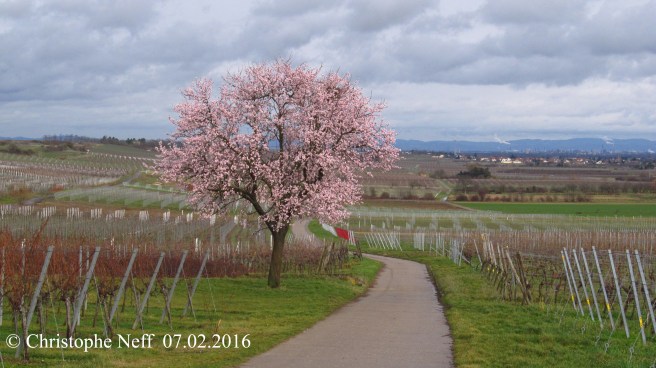
Bloming Almond tree (Prunus amygdalo-persica (West) Rehd.) 07.02.2016 near Herxheim am Berg (Germany), © Christophe Neff 07.02.2016

« Elle s’appelait Ruqia » – her name was Ruqia. That’s the beginning of a very notable commemorative address for Ruqia Hassan Mohammed, written by the French journalist Alain Frachon and published in the print edition of Le Monde of Friday the 5 February 2016. Ruqia Hassan was a citizen journalist who wrote under the nom de plume of Nissan Ibrahim about here daily life in Raqqa, which is currently ruled by the jihadists of the Islamic state. She was murdered[1] by Isis because she had the courage to witness daily live in Raqqa under the rule of jihadists[2] (the online version of the Alain Frachon text begins “Elle s’appelait Ruqia et racontait son quotidien sous la botte des djihadistes” Her name was Ruqia and she told us her daily live under the rule of the jihadists).

It’s dangerous to tell the truth about daily live in Syria   ….. in regions ruled by Bashar al-Assad  citizen journalists (as many other people) face torture and death – in regions ruled by jihadist’s it’s the same – citizen journalists (as many other people) face torture and death. The current geography of Syria is a map painted with the blood of innocent citizens, – a landscape of torture, murder, manslaughter …. a geography of beheading, crucifying, …. a desert of desperation, hunger and solitude.

When reading the memoir text of Alain Frachon I thought, – that the Le Monde should have had translated the text in English, – as they have done it in very rare occasions, as for example the report “Chemical warfare in Syria” in June 2013. So perhaps more people would know more about the tragic live of Ruqia, but also more people would know what the courageous citizen journalists of “Rakka is Being Silently Slaughtered” do – and for what they risk their live every day.

For copyright reasons it’s impossible to translate the full text of Alain Frachon report – but I think the last sentence of the memoir is worth to be completely translated “Peut-être y aura-t-il un jour une plaque, quelque part dans Rakka libérée, à la mémoire d’une jeune femme qui a défié les petites frappes de l’EI et qui portera ce nom : Ruqia Hassan Mohammed./ Perhaps one day, somewhere in Raqqa liberated, there will be a commemorative plaque, in honor of a young woman who challenged IS, – Ruqia Hassan Mohammed (free translation C.Neff).

Photo: © Christophe Neff 07.02.2016

Christophe Neff, Grünstadt the 07.02.2016

P.S.: Instead of posting of photo of Ruqia (you can find photos of her in the two articles of the Guardian I mentioned in the footnotes (1,2)) I preferred to post the picture of a blooming almond tree, which I photographed today in the vineyards of the Unterhardt between Freinsheim and Herxheim am Berg. The almond tree is in almost the whole Mediterranean world a symbol for the beginning of springtime.

Source:

Frachon, Alain (2016) : Elle s’appelait Ruqia et racontait son quotidien sous la botte des djihadistes. In Le Monde, Vendredi 5 Fevrier 2016, p. 19 (for le Monde subscribers download here).

[1] Aisha Gani and Kareem Shaheen : “Journalist Ruqia Hassan murdered by Isis after writing on life in Raqqa”, The Guardian, Tuesday 5 January 2016

[2] Homa Khaleeli, Aisha Gani Mona Mahmood and Mais al-Bayaa: Ruqia Hassan: the woman who was killed for telling the truth about Isi, The Guadian, Wednesday 20 January 2016

Vue de Grünstadt 02.04.2015: Vue sur le paysage urbain de Grünstadt

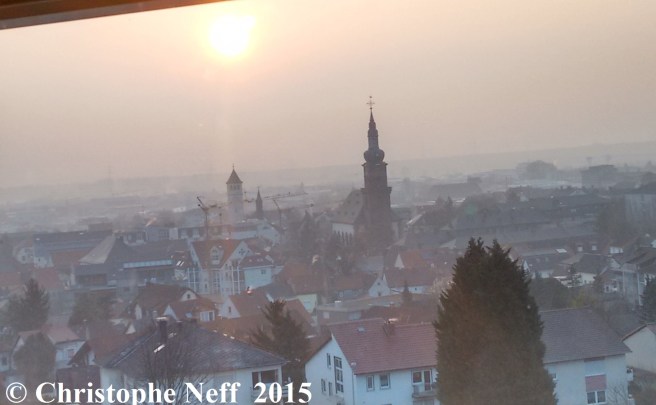
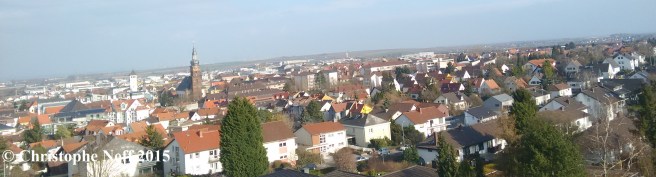
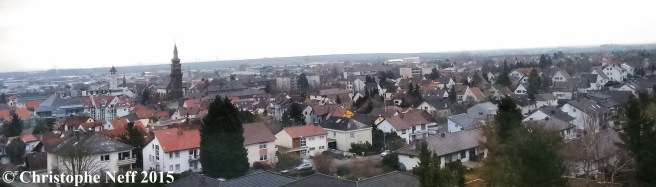
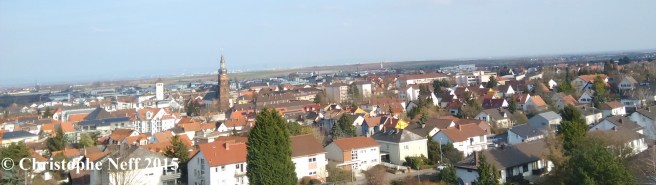
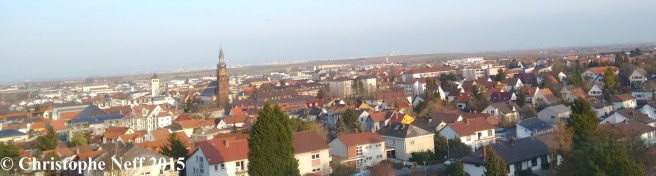
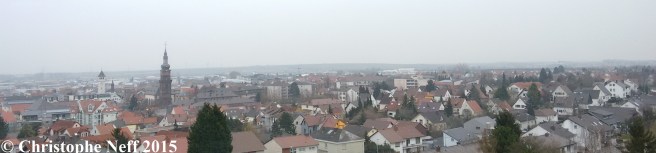
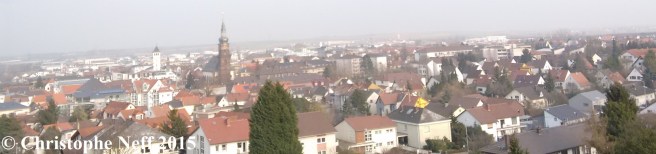
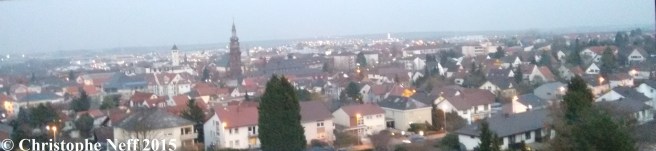
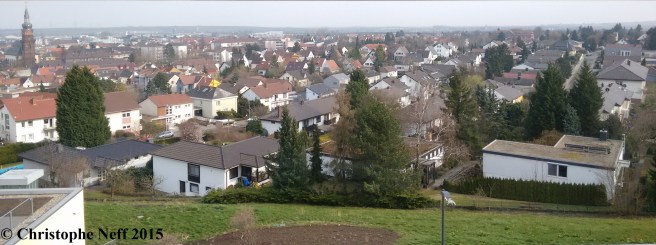
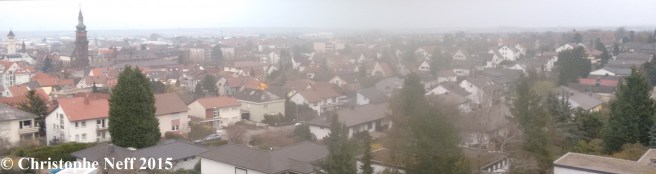
Confiné pendant plusieurs jours dans une chambre de l’Hôpital de Grünstadt (Kreiskrankenhaus Grünstadt) après une opération chirurgicale au genou, j’ai essayé de prendre tous les jours une photo du paysage urbain de Grünstadt depuis mon lit d’Hôpital. Tous les jours, même tous les heures des couleurs différentes, la lumière changeant dans un paysages structuré urbain, structuré par le « Westring » – l’autoroute A 6 (d’ailleurs une des plus anciennes autoroutes allemandes), les deux églises – l’église protestante de St.Martin (clocher couleur brun-rouge de grès) et l’église catholique St. Peter (clocher couleur blanc) – au fond, les vignobles de la Unterhaardt, et parfois même à l’horizon, on peut même reconnaitre les cheminées du Großkraftwerk (centrale electrique) à Mannheim-Neckarau et ainsi que la ville de Ludwigshafen avec le grand complexe industriel de la BASF. Dans cette vue du paysage urbain de Grünstadt, la vue d’ensemble est séparée par une ligne imaginaire, où on peut reconnaitre avec un peu de « Ortskenntnis » (connaissance des lieux) la ligne de chemin de fer Grünstadt – Bad Dürkheim.

Vue de Grünstadt 9 22.03.2015 17.27

Notons que la Unterhaardt, ces coteaux à caractère subméditerranéen entre Grünstadt et Bad Dürkheim, qui est un des rares paysages allemands presque entièrement dominés par le vignoble, n’a jusqu’à présent pas d’article sur la wikipedia allemande. On trouve un peu de tout sur la Wikipédia allemande, mais sur la Unterhaardt on ne trouve absolument rien, ceci me semble assez étrange[1].

En regardant les lumières et couleurs changeantes du paysage urbain de Grünstadt, je pensais aussi à Christoph Jentsch, professeur de géographie humaine, récemment décédé qui fut un de mes maitres. Je me souviens, qu’il disait – „Landschaft ist ein Bildauschnitt, ein Blickwinkel“ – le paysage est une partie d’un tableau, un angle de vue. Donc la notion de paysage est toujours liée à l’homme, à l’inverse de l’écosystème – qui existe et qui existera sans l’intervention de l’homme. Sans la vue de l’homme sur un espace – pas de Landschaft, pas de paysage, pas de landscape. Ces paroles furent, si je me souviens bien, prononcées pendant la préparation du projet de recherche « Neuscape » – « Nested ecological understanding of changing cultural landscapes”. Comme assistant de Peter Frankenberg, à la chaire de géographie physique de l’Université de Mannheim[2], je fus chargé de préparer pour Peter Frankenberg et Christoph Jentsch en collaboration avec Shivcharn S. Dhillion[3], James Aronson, François Romane, Edouard Le Floc’h et Anne Grossmann[4] une demande de financement de la Communauté européenne pour un projet de recherche sur un transecte de paysages européens allant de la Norvège à l’Espagne du Sud, incluant des paysages en Norvège, Allemagne (Palatinat et Forêt Noire), France (Midi français incluant les garrigues de Nîmes, les Costières de Nîmes, les site Cazarils du CEFE, Corbières et Cap Leucate,) – les paysages de Montado au Portugal et des paysages espagnols de l’Andalousie méridionale. Finalement le projet ne fut jamais financé par la communauté européenne, mais à titre personnel, en préparant cette demande de financement j’ai beaucoup appris sur les paysages européens et aussi sur le fonctionnement de la fameuse DG XII pendant les années Cresson. L’acronyme du projet « Neuscape » étaient d’ailleurs librement inspiré du Netscape navigator, – qui était durant les années 1990 le navigateur web dominant. Tout cela maintenant appartient à l’histoire, mais les mots du Professeur Jentsch sur la « Landschaft » me semblent inoubliables.

Donc en prenant en photo les différents couleurs des paysages urbains de Grünstadt avec mon smartphone, je pensais à ces mots que le Professeur Jentsch avait exprimés durant les années 1990 sur les paysages et Landschaften. Beaucoup de lecture aussi, durant ces jours dans mon lit d’hôpital. Je finissais les derniers chapitres du « dictionnaire amoureux du Brésil », dont j’avais déjà parle dans Bala l’homme de la forêt. Je traversais le paysages de cimetières sous-marins avec « Edgar Bentler dit Ed » entre Hiddensee, Rügen et le Danemark (l’ile de Møn) , – dernier chapitre du roman « Kruso » de Lutz Seiler, dans lequel est thématisé le destin tragique de « Republikflüchtlinge», qui essayèrent de traverser la mer baltique pour fuir la DDR et de rejoindre le Danemark à la nage, en planche à voile, etc. et dont la fuite pour la plus grande majorité trouva une fin tragique dans les fonds de la mer baltique. Le roman de Lutz Seiler qui fut récompensé par le Uwe Johnson Literaturpreis et le Deutsche Buchpreis 2014, mériterait certainement une traduction en français.

Un autre paysage que je traversais avec l’aide d’une lecture fort intéressante, fut la carte cognitive des fonds philosophiques des pensées Poutinienes, que je découvris dans le petit livre de Michel Eltchaninoff[5] qui porte le titre programmatique « Dans la tête de Vladimir Poutine ». Ayant comparé dans une petite notice de blog publié en décembre 2013, Monsieur Poutine avec Nicolas Ier de Russie, cette lecture du livre de Michel Eltchaninoff, semble confirmer mes pensées (et même au-delà) assez sceptiques envers la politique neo-imperialiste du nouveau Tsar. Le livre finit avec ces phrases remarquables « Désormais, grâce au plan le plus nationaliste et pseudoscientifique de la philosophie russe, Poutine rend à la Russie sa vocation idéologique internationale. Le conservatisme identitaire doit devenir un phare pour tous les peuples du monde.  La mobilisation conservatrice, initiée et dirigée par le Kremlin, n’a plus de frontières. L’URSS n’était pas un pays, mais un concept. Avec Poutine, la Russie est à nouveau le nom d’une idée. » Un livre intéressant, -un livre qui mériterait une traduction anglaise, allemande, – et même au-delà. En ce qui concerne une traduction allemande potentielle du livre de Michel Eltchaninoff, celle-ci devrait être lue par tous les membres du Auswärtiger Ausschuss du Bundestag. Et pour finir je commençai les premiers chapitres de « Schubert’s Winter Journey » de IAN Bostridge, livre que j’avais découvert il y a quelques semaines dans la République des Livres – grâce au billet au titre prometteur « Schubert tel que vous ne l’avez jamais lu » – ce billet, et cela mérite d’être signalé, est ,si je suis bien renseigné, un des rares billets de Pierre Assouline, qui nous présente un livre anglais dont la traduction française se fait attendre. Mais peut être le billet enthousiaste de P.A. incitera un éditeur français ou francophone de se lancer dans la traduction de l’ouvrage.

Le jour où je sortais de l’Hôpital je découvre les premiers Forsythia de Paris (Mimosa de Paris) en fleurs à Grünstadt, -et dans mon jardin je découvre les premières branches de notre Abricotier qui commence à fleurir – le printemps semble réellement s’installer dans les paysages de la Unterhaardt. Mais ce même jour je découvrais aussi à quel point la tragédie du vol vol 4U9525 Germanwings qui s’est écrasé dans le Massif des Trois-Évêchés avait traumatisé l’Allemagne. Mais ceci est une autre histoire. D’ailleurs Dirk Kurbjuweit dans le dernier Spiegel (14/2015) a écrit un commentaire intéressant sous le titre « Ohne festen Boden – Das Flugzeugunglück beendet den Mythos von deutscher Sicherheit ». Depuis quelques jours ont passé, – l’ouragan Niklas vient de traverser l’Allemagne, mais notre Abricotier en pleines fleurs maintenant a bien résisté, – le printemps est maintenant bel et bien arrivé sur les coteaux de la Unterhaardt, même si nous risquons peut être encore de voir tomber quelques flocons de neiges pendant le week-end pascal. Mon radius d’action est encore assez limité, je viens de commencer un nouveau livre … –  « le dictionnaire amoureux de l’Alsace » de Gilles Pudlowski. C’est un livre qui nous parle avec amours des paysages alsaciens, de ses villes et villages, de ses écrivains et artistes, de son art gastronomique … un livre qui mérite encore la lecture et qui mériterait aussi une traduction et adaptation allemande, même si il y déjà été édité en 2010 – je crois même qu’une édition allemande pourrait devenir un succès commercial dans le « Buchhandel » allemand. C’est aussi un livre plein de découvertes, – au moins pour moi, – et c’est ainsi que j’ai découvert le poète-écrivain-résistant Jean Paul de Dadelsen.

Dans ce livre de Gilles Pudlwoski j’ai particulièrement savouré le chapitre dédie à la ville de Wissembourg. Passer une belle journée a Wissembourg, voir ce qu’il y de nouveau dans la librairie «à livre ouvert» chez Willy Hahn, est ce que je trouverai « Goethe en Alsace » de Jean Paul de Dadelsen ? Déjeuner au Cygne – peut être une Grumbeeredetchl » au saumon fumé, chantilly au raifort et petite salade de saison – et après passer chez la pâtisserie – chocolaterie Rebert pour quelques gourmandises avant de faire une belle promenade entre Rott, Cleebourg et Drachenbronn longeant les vignes et les lisières des belles forêts des Vosges du Nord. Naturellement je rêve, – en ce moment je marche avec des béquilles, et pour le Week-end les services météorologiques allemands nous annoncent des chutes de neige même en plaine … mais le dictionnaire amoureux de l’alsace est un livre qui nous invite à rêver de ce beau paysage, ce beau jardin l’Alsace !

Photos sélectionnées du paysage urbain de Grünstadt prise depuis ma chambre d’hôpital entre le 20.3 – 26.3.2015.

Vue  sur Grünstadt, 21.03.2015  6:44

Vue  sur Grünstadt, 21.03.2015  6:48

Vue  sur Grünstadt, 21.03.2015  16:28

Vue  sur Grünstadt, 22.03.2015  8:43

Vue  sur Grünstadt, 22.03.2015  16:22

Vue  sur Grünstadt, 22.03.2015  17:27

Vue  sur Grünstadt, 23.03.2015  13:18

Vue  sur Grünstadt, 23.03.2015  16:48

Vue  sur Grünstadt, 23.03.2015  19:01

Vue  sur Grünstadt, 25.03.2015 15.37

Vue  sur Grünstadt, 26.03.2015  7:06

Photos: toutes © Christophe Neff 2015

Sources, livres etc. :

Bostridge, Ian (2015) : Schubert’s Winter Journey. Anatomy of an Obsession. London, (Faber & Faber), ISBN 978-0-571-28280-7

Eltchaninoff, Michel (2015): Dans la tête de Vladimir Poutine. Essai. Arles (Solin/Actes Sud), ISBN 978-2-330-03972-1

Lapouge, Gilles (2011):   Dictionnaire amoureux du Brésil, Paris, (Plon), ISBN 978-2-259-20925-0

Kurbujuweit, Dirk (2015): Ohne festen Boden – das Flugzeugunglück beendet den Mythos von deutscher Sicherheit. In: Der Spiegel, 14/2015, p. 14

Pudlowski, Gilles (2010): Dictionnaire amoureux de l’Alsace. Dessin d’Alain Bouldouyre. Paris, (Plon), ISBN 978-2-259-20947-2

Seiler, Lutz (2014): Kruso. Roman. Berlin (Suhrkamp Verlag Berlin), ISBN 978-3-518-42447-6

Christophe Neff, le 02.04.2015

P.S. (05.04.2015 11:00): Le billet fut publié le 02.04.2015, depuis le 04.04.2015 nous trouvons dans la Wikipédia française un article sur « Michel Eltchaninoff ».

[1] On trouve une description des paysages de la Unterhaardt sur le site Lanis (Landschaftsinformationssystems der Naturschutzverwaltung Rheinland-Pfalz) ici.

[2] L’institut de géographie de l’Université de Mannheim fut fermé du au mesure de restructuration universitaire entame pas le rectorat Arndt. Christoph Jentsch en 2009 à édite un livre sur l’histoire de la géographie à l’Université de Mannheim sous le titre: « Das Fach Geographie an der Mannheimer Hochschule 1907 bis 2006. Eine Dokumentation von Christoph Jentsch ». Dans paysages j’ai consacré en 2009 un article (en allemand) a cette documentation édité pas Christophe Jentsch sous le titre « Das Fach Geographie an der Mannheimer Hochschule ».

[3] Durant la préparation de Neuscape Shivcharn S. Dhillion était chercheur – enseignant à l’université de Oslo en Norvège.

[4] James Aronson, François Romane, Edouard Le Floc’h et Anne Grossmann étaient à cette époque membres du CNRS-CEFE à Montpellier. Dans les années le CEFE s’appelait encore Centre d’Ecologie Fonctionnelle & Evolutive, CEPE Louis Emberger en mémoire du phytogéographe Louis Emberger.

[5] En écrivant ce texte, je découvre qu’il n’existe pas d’article sur Michel Eltchaninoff dans la Wikipedia française. Dommage, – car Eltchaninoff aurait surement mérité un article dans la wikipedia.fr

Aschermittwochsblognotiz 2013 – eine bemerkenswerte Begegnung beim Schramberger Hanselsprung am Fasnetssonntag 2013 (10.2.2013)

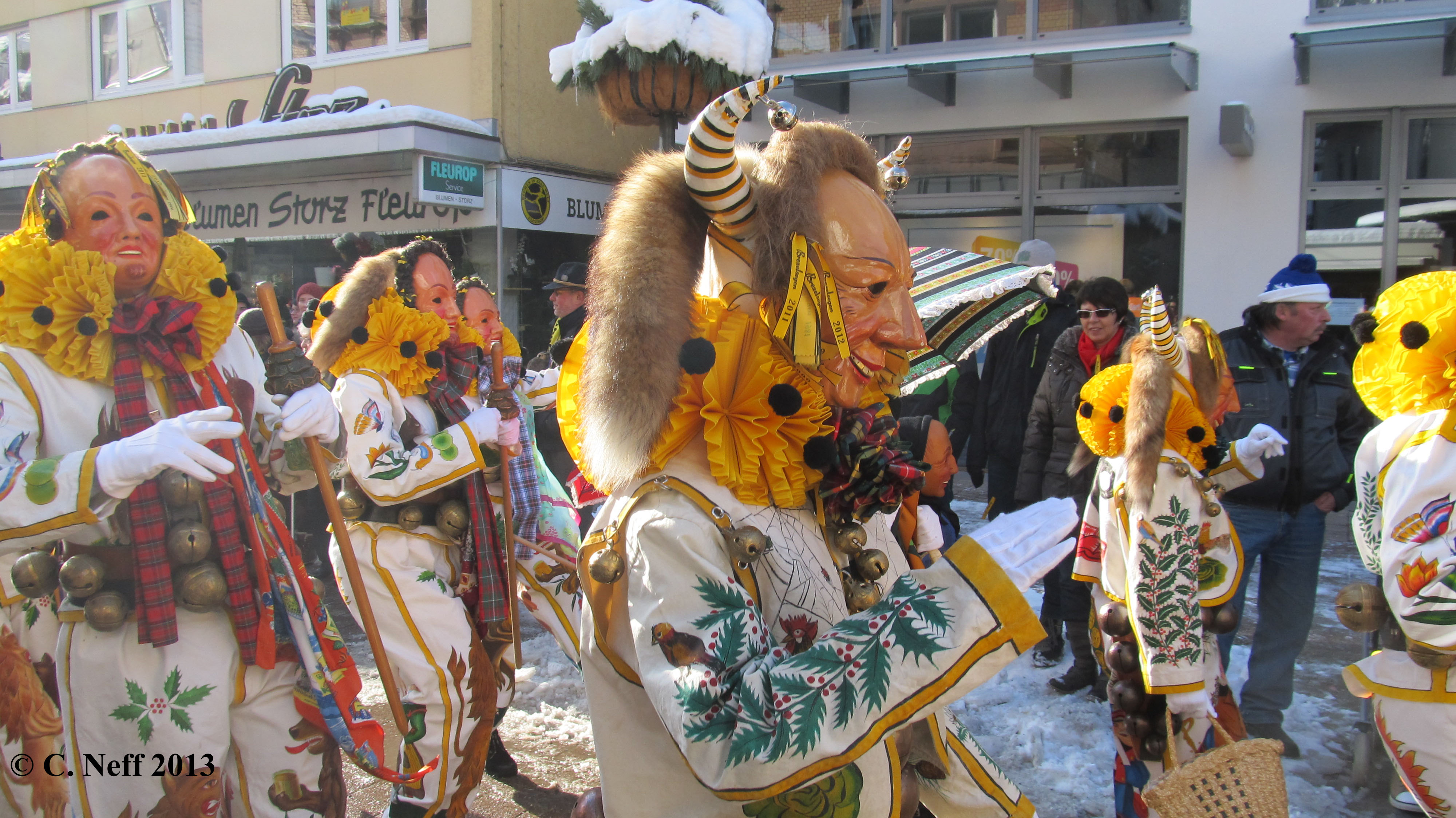
Narro + Hansel, Hanselsprung Schramberg 2013
Narro + Hansel, Hanselsprung Schramberg 2013, © C. Neff 2013

Wie so viele Schramberger Expatriierte komme ich relativ regelmäßig, – zwar nicht jedes Jahr, aber dennoch relativ oft, zuletzt im Jahr 2011 zur Fasnet nach Schramberg zurück. Die „Da-Bach-na-Fahrt“ und der danach stattfindende Rosenmontagsumzug ist bestimmt  der überregionale bekannteste  Höhepunkt der Schramberger Fasnet, – wobei es auch andere „Highlights“ gibt die den Vergleich mit der Da-Bach-na-Fahrt nicht scheuen brauchen.  Aus meiner Sicht ist das immer noch der Hanselsprung mit anschließendem Brezelsegen welcher  traditionell am Fasnetssonntag stattfindet. Die NRWZ  hat das, mit der Schlagzeile „Hanselsprung für tausende Besucher ein rezeptfreies Antidepressivum – Hoorig, hoorig – Schramberg im Glückstaumel“  zum diesjährigen Hanselsprung sehr sehr gut getroffen. Ja, dieses Jahr hat es mich auch wieder auf die Fasnet nach Schramberg gezogen, – Hanselsprung am Fasnetssonntag,  die Da-Bach-na-Fahrt und der Rosenmontagsumzug standen wieder auf dem Programm.

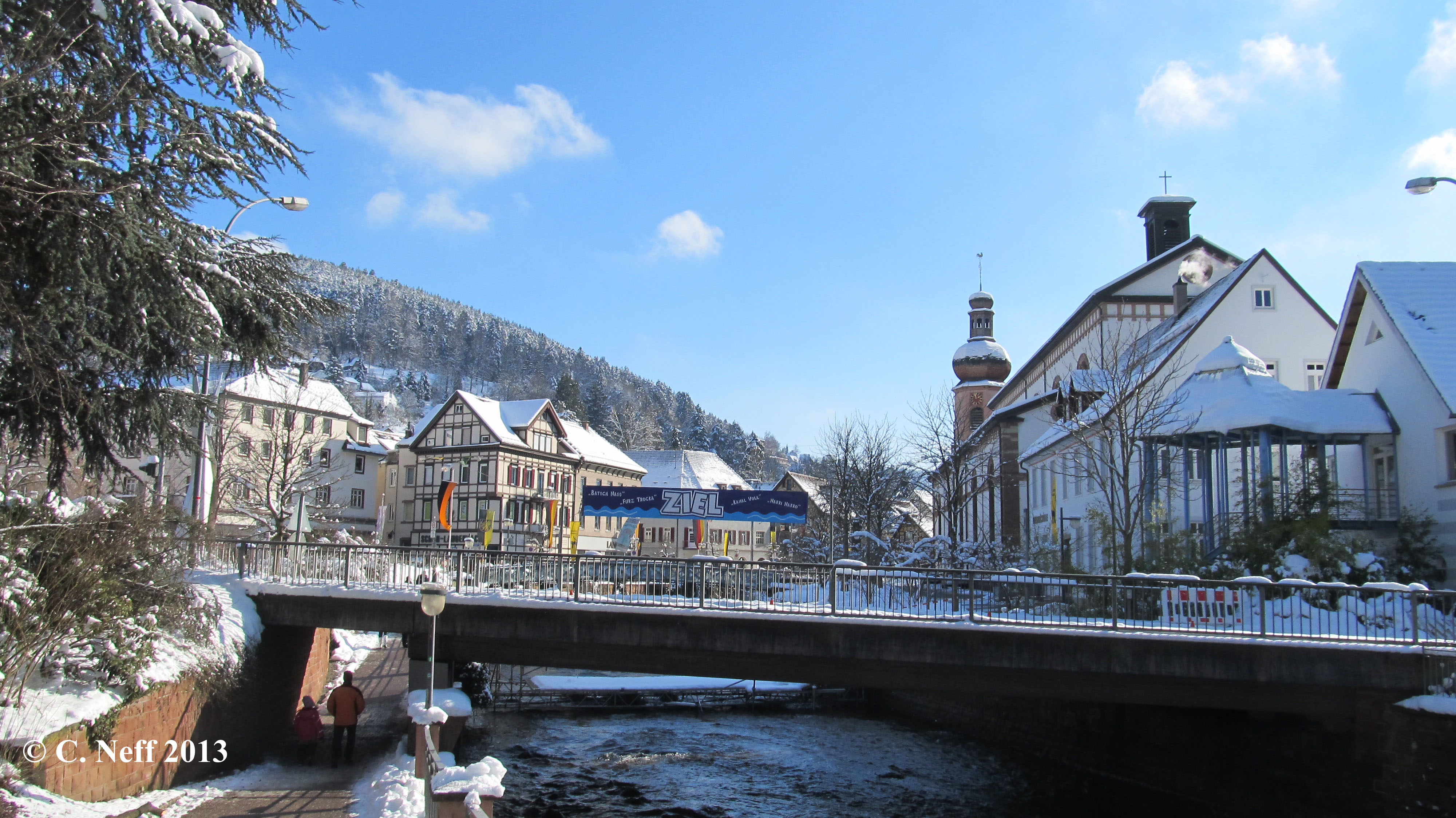
Winterhimmel und Februarschnee in Schramberg
Winterhimmel und Februarschnee in Schramberg, © C. Neff 2013

Am Fasnetssonntag 2013 lachte die Sonne über Schramberg, – beglückte die Kleidlesträges und Zuschauer mit einem stahlblauen Winterhimmel. Das Februarlicht wurde von den Schneekristallen auf den Fichten und Tannen der Bergwälder des Schramberger Talkessels  vielfach reflektiert und tauchte die Talstadt in ein fast gleißendes Licht.  Und irgendwann gegen 14:30 ertönte dann die „Hoorig Katz“, – der Schramberger Narrenmarsch,- und vermischt mit dem Geschell der Hansel und Narros –  wurde die Talstadt zu einem einzigartigen akustischen Amphitheater – Hoorigkatz und Geschellenläuten verdichten sich im engen Schramberger Talkessel zu dieser einzigartigen Klanglandschaft –  die man nur an der Fasnet erleben kann. The unique „soundscape“ of the „Schramberger Hanselsprung“ so  könnte man  einen noch zu schreibenden wissenschaftlicher Artikel über den Schramberger Hanselsprung  und dessen (Klang)- Landschaften betiteln. Diese „Tonlandschaften & Klangwelten“ kann man übrigens auch erleben, wenn die „Wintersonne“ nicht gar so strahlt wie am Fasnetssonntag 2013.

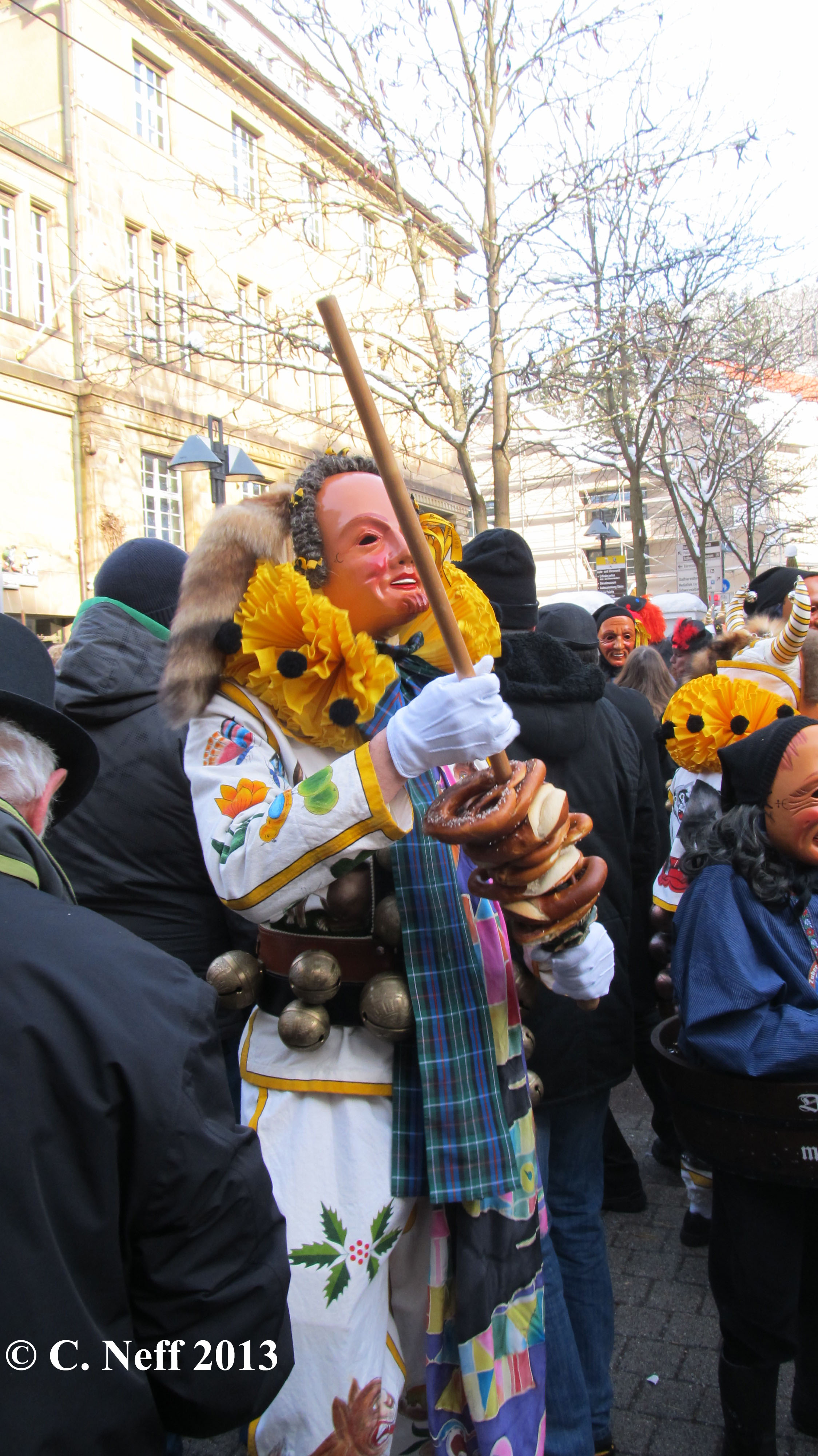
Ja, und am Hanselsprung des Fasnetssonntag 2013, hatte ich während des Brezelsegens eine bemerkenswerte Begegnung mit einem „großen Hansel“.  Wir (.d.h. meine Tochter und meine Nichte) hatten uns schon ein paar Brezeln und Guzzle ersungen, da bemerkten wir einen sehr großen Hansel , der auf uns zukam.  Wir begann zu springen und die „Hoorig Katz“ zu singen. Der Hansel unterbrach mich per Handzeichen und unter der Maske erklang eine Männerstimme – „auf Französisch bitte“ – worauf ich so perplex war, – dass ich erst einmal verstummte. Dann ertönte es unter der Maske “en français Christophe“ – und ich erwiderte „die Hoorig Katz auf Französisch?“ – worauf der große Hansel nickte. Und so begann ich zur Melodie der Hoorig Katz  zur ersten Strophe anzusetzen „le chat n’a pas de poils“ – doch gleich wies mich der große Hansel mit einer Handbewegung an zu stoppen –  denn er hatte erkannt das das falsch war – denn richtiger weise heißt es „le chat a des poils“. Also versuchte ich dann mit „le chat a des poils“ – und bekomme dann endlich auch meine Brezel.  Die Brezel in der Hand, fällt mir ein, dass es eigentlich ganz korrekt „le chat poilu, le chat poilu, le chat poilu – et si le chat n’est pas poilu il ne plait guère aux filles – le chat poilu“ – aber da war der große Hansel schon längst wieder im Gewühl verschwunden. Ja, da waren wir (d.h. ich und meine zwei Begleiterinnen) doch alle sehr sehr überrascht, – ein großer Hansel (bestimmt ein Kopf größer als ich)  – der sich die „Hoorig Katz“ auf Französisch vorsingen lässt. Die Schramberger Fasnet ist wirklich für Überraschungen gut. Wer der große Hansel war, der mich die Hoorig Katz auf Französisch vorsingen ließ, weiß ich nicht, – die Stimme habe ich nicht zuordnen können, und unter Larve und Häs ist es sowieso sehr schwer jemanden zu erkennen.

großer Hansel - Hanselsprung Schramberg 2013
großer Hansel – Hanselsprung Schramberg 2013, © C. Neff 2013

Wer es auch immer gewesen sein mag, – das war wirklich ein gelungener „Fasnetsstreich“ – ein Fasnetsstreich der mir fast die Sprache verschlug – ich hatte wirklich Schwierigkeiten die Hoorigkatz aus dem Stehgreif zu übersetzten. Weiterhin hatte dieser „Fasnetsstreich“ auch einen gewissen Esprit, – die Hoorig-Katz auf Französisch auf singen zu lassen – denn  immerhin feierte man 2013 die 50 Jahre Élysée-Vertrag  (hierzu auch die Beiträge: Blognotice 22.01.2013: pensées personnelles franco-allemandes sur le cinquantième anniversaire du Traité de l’Elysée; Blognotice 30.12.2012: Réflexions sur « les Zungenknoten – ungebetene Gäste» de Martin Graff;  Blognotice 22.09.2012: Commémoration du discours historique de Charles de Gaulle du 9.9.1962 à Ludwigsburg). Weiterhin gehört Schramberg, dank der Initiative und Tatkraft des Bürgermeister Konstantin Hank, zu den ersten deutschen Städten die nach dem zweiten Weltkrieg, eine Städtepartnerschaft mit einer französischen Stadt aufnahmen. Im Jahres 1958, also schon fünf Jahre vor dem Abschluß des Élysée-Vertrages, wurde diese Städtepartnerschaft zwischen Hirson und Schramberg geschlossen.

Diese Begegnung mit dem großen Hansel auf dem Schramberger Hanselsprung am Fasnetssonntag 2013 wird mir wohl sehr lange in Erinnerung bleiben.  Soweit es die Schramberger Narrenzunft erlaubt, werde ich den gesamten Schramberger Narrenmarsch, – die berühmte „Hoorig Katz“ komplett ins Französische übersetzten und hier im Paysagesblog veröffentlichen.

Die Fasnet ist nun wieder vorbei, – der Aschermittwoch kündigt das Osterfest und die dazwischen liegende „Fastenzeit“ an. Nun wird es wieder ein Jahr dauern bis der Schramberger Talkessel von Schellenlärm und d’Hoorig Katz in sein sonderbares Klangbad eingetaucht werden wird. Ein Klangbad, welches das Ende des Winters und den baldigen Frühlingsbeginn ankündigt.

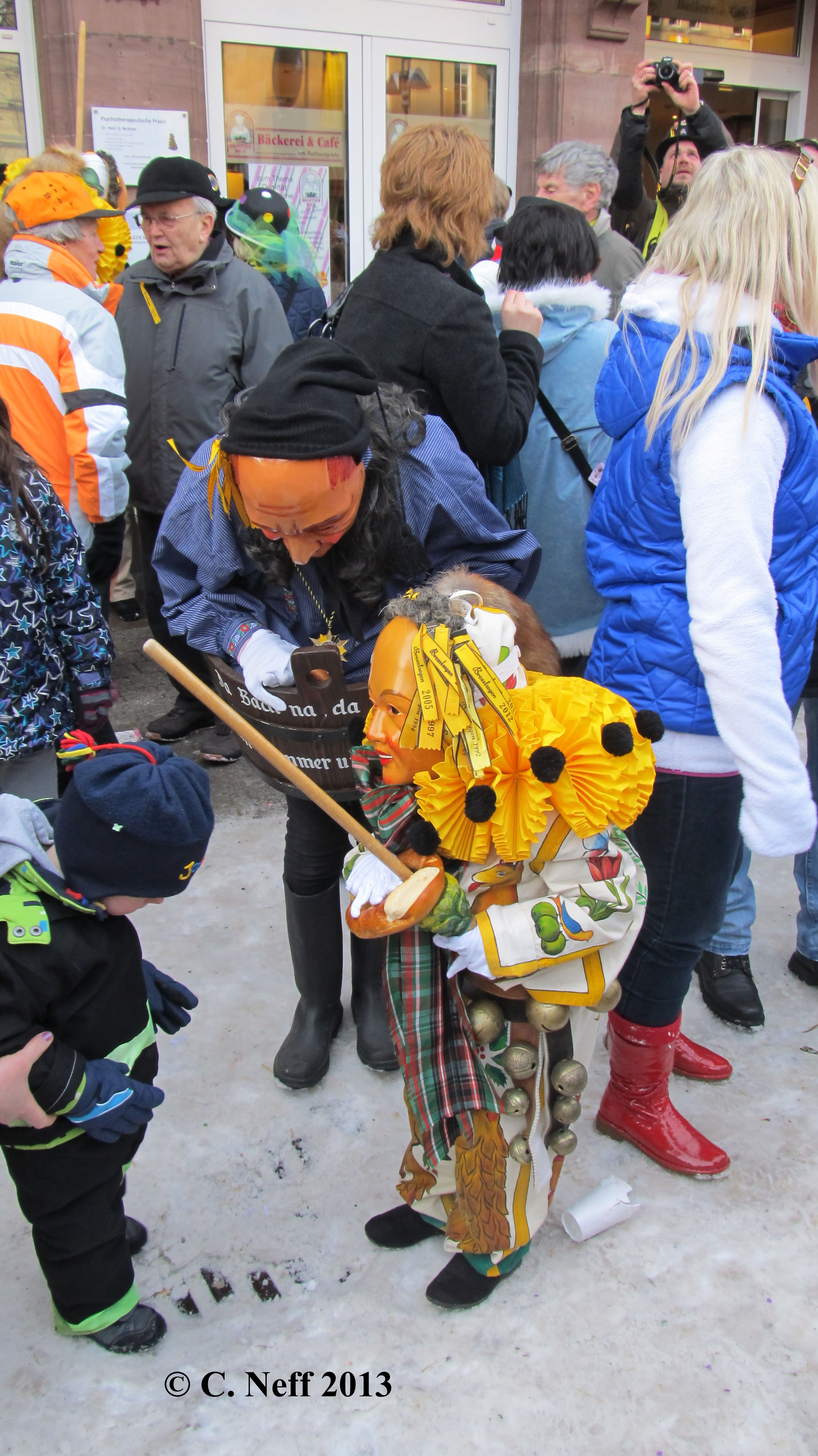
kleiner Hansel + Da Bach na Fahrer, Hanselsprung Schramberg 2013
kleiner Hansel + Da Bach na Fahrer, Hanselsprung Schramberg 2013, © C. Neff 2013

Die Begegnung mit dem großen Hansel, erinnerte mich an meine frühen Kindheitstage, – als ich, noch als ganz kleiner „Bua“ den Großeltern von den tollen Schramberger Hanseln erzählte. In Saulgau (damals noch ohne Bad) bei den Großeltern väterlichseits gab es zwar die auch sehr schönen „Dorausschreier“  mit ihrem bekannten  Narrenruf „Doraus, detnaus, bei der alte Linda naus.“  aber mit den Schramberger Hanseln und auch den Sulgener Krattenmacher konnten diese Saulgauer Narrenfiguren  in meinen damaligen Kinderaugen nicht bestehen. Bei den Großeltern mütterlicherseits, dem französischen Teil der Familie, – die Großeltern Migliori wohnten damals noch in Eckbolsheim bei Strasbourg – da waren es einfach die „ les fabuleux Hansel de Schramberg“.

Eh, oui – parfois ces fabuleux Schramberger Hansel comprennent  et parlent  même un peu de français.

Photos: alle © C. Neff 2013 ; Narro + Hansel; Winterhimmel und Februarschnee in Schramberg; großer Hansel; kleiner Hansel + Da – Bach – na-Fahrer; (alle vom Schramberger Hanselsprung 2013)

Christophe Neff, 13.02.2013