Blognotice “27.10.2024” :  America where are you going ?

Good morning, America, how are you?
Say, don’t you know me? I’m your native son.
I’m the train they call the City of New Orleans
.”  (City of New Orleans, Steve Goodman)[1]
During my university years I was also singing a little bit in bar & cafés – and the “City of New Orleans” belonged to my singing repertoire with other songs, mostly French chansons which I used to sing in bars & cafés in Mannheim and in my hometown Schramberg[2]. Singing those songs, – was also a sort of dreaming of the American landscapes. But still I have never been in the United States of America!

I am belonging to a generation for which the USA are still the land of Liberty. In German we often call the USA “das Land der unbegrenzten Möglichkeiten” – “the  land of unlimited possibilities”. So sometimes I think, – that after retirement, if America is still a liberal democracy I will try to visit the US, and travelling around there by train. But will the US still be the land of freedom and liberty? Observing the presidential elections of 2024 I have some doubts. I hope Kamela Harris will win the election, but I fear Donald Trump could win this 2024 presidential race. In 2016 I was one of the rare persons forecasting in some way the victory of Donald Trump[3]. Now it seems that it will be a head-to-head race. A victory of Donald Trump would be a disaster for freedom and liberty of the whole planet earth. The Ukraine would also be put into a very difficult situation by a new Presidency of Donald Trump[4]. Imagining Trump turning the USA, the land of freedom, into an authoritarian state is a nightmare. In some way the 6 January 2021 was a pretaste of that nightmare[5] !

But I think currently Kamela Harris has still a chance to win this fateful presidential election. If she wins, and I hope she will win, I will try to travel through the US by train, after my retirement in some years! But currently as an attentive observer of the us political landscape, I can only wait until the 5 of November, – and sometimes share texts and videos etc. on #Mastodon for Harris Walz – as I did with the video message from Timothy SnyderObeying in advance Media billionaires ask for tyranny” and other messages I shared.

Closing my eyes, singing the City of New Orleans, – imaging me riding on a train through the US, – the City of New Orleansthe Adirondack, California Zephyr,  Coast Starlight and other trains…,  remembering “Amtrak Joe”, – the nick name of Joe Biden[6]. Never forget his courageous decision to withdraw his candidacy for presidential election in July 2024. So he levelled the way for the Kamela Harris & Tim Walz candidacy.

I have a schoolmate living in a town in the West US, which has an Amtrak Station served by the California Zephyr. Perhaps I would make a stop there, – to visit her and her family. 40 years ago we took our Abitur together in the Gymnasium Schramberg in the Black Forest town of Schramberg. She has become an American Citizen and has publicly endorsed for Kamala Harris on Facebook. I have had other schoolmates living in the USA, – but for different reasons they all come back to “old Europe”. Perhaps one day I should ask them, why they left the US and come back to Europe? Geography, family, distance, new love, new job – or other reasons ?

40 years ago, as a high school student in the Gymnasium Schramberg, I could never have imagined that the USA – the land of freedom – the land of unlimited possibilities – would turn into a proto-fascist authoritarian state! That would probably happen if Trump wins the presidential election on Tuesday, November 5, 2024!

America where are you going  ?

Good morning, America, how are you?
Say, don’t you know me? I’m your native son.
I’m the train they call the City of New Orleans
.” (City of New Orleans, Steve Goodman)

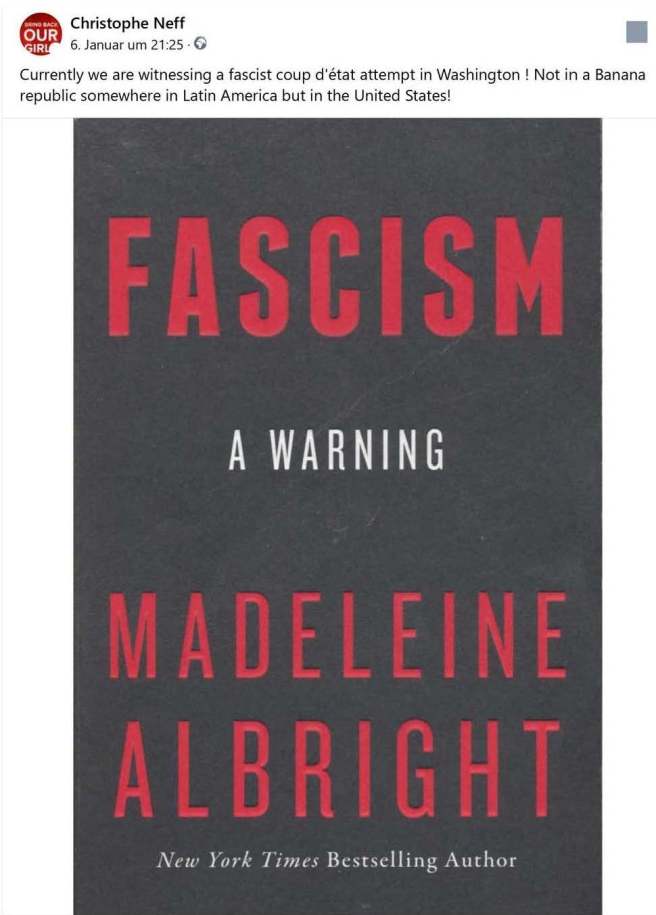
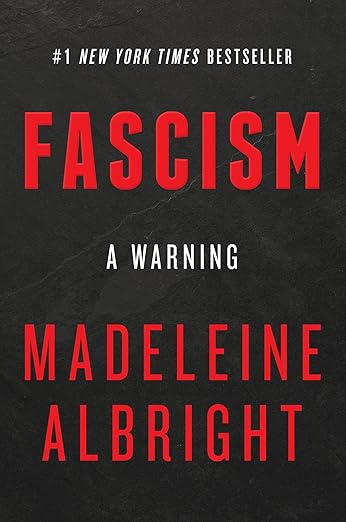
Ilustration: Book Cover of Albright, Madeleine; Woodward, Bill (2018): Fascism a warning (with Bill Woodward). London, 2018. ISBN 978-0-00-828227-1 which I also used in the post “Witnessed from Grünstadt: The storm of the United States Capitol on Epiphany 2021

Christophe Neff, Grünstadt 27.10.2024


[1] Here you can find a link to a youtube version (Arlo Guthrie interpretation) including lyrics of the City of New Orleans!  

[2] See also „Mannemer Dreck- traumhafte Zeiten – eine autobiographische Zeitreise mit Musikbegleitung nach Mannheim (in German)

[3] See also „Blognotice 02.11.2020: Donald Trump peut – il encore gagner ? and « Rétrospectives sur le blog paysages en 2016 – les billets les plus lus de « paysages » en 2016 ». The second post includes a screenshot of my Facebookpost of the 05.11.2016 in which i predicted the victory of Donald Trump.

[4] See also “L’année 2023 sur le blog paysages – une rétrospective/eine Rückschau auf das Jahr 2023 im Paysagesblog” and „Blognotice 18.08.2024: de retour à Grünstadt – et les martinets se sont déjà envolés vers le Sud„.

[5] See also „Witnessed from Grünstadt: The storm of the United States Capitol on Epiphany 2021

[6] See also “„Where Did „Amtrak Joe,“ Joe Biden’s Nickname, Come From? What may be Joe Biden’s most enduring nickname, Amtrak Joe, began out of family tragedy and morphed into a lifelong support of the railway” . Marie Clarie, May 2020

Blognotice 18.08.2024: de retour à Grünstadt – et les martinets se sont déjà envolés vers le Sud

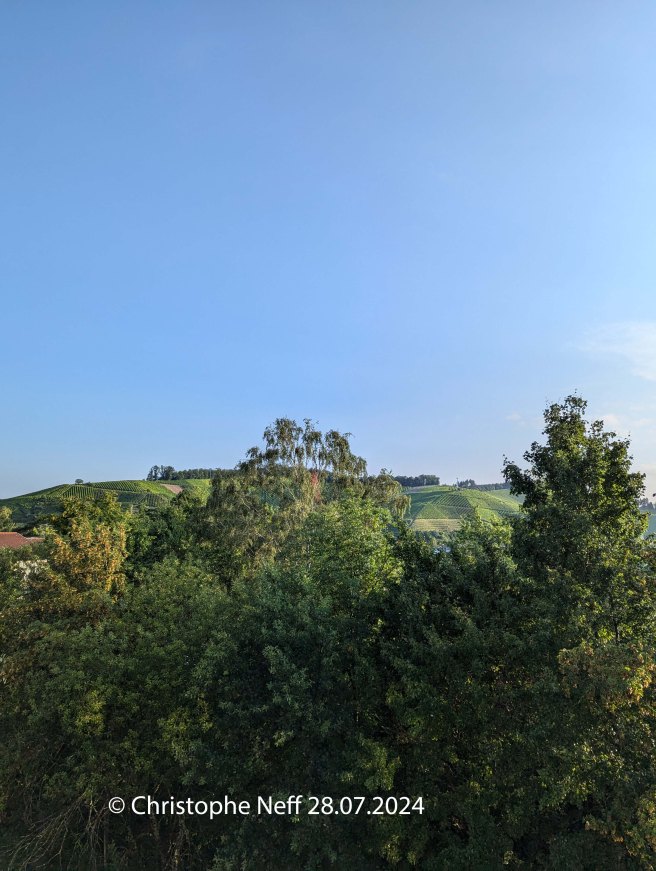
Vue depuis ma chambre d’hôpital à Durbach/ Blick aus meinem Krankenhauszimmer Durbach, © Christophe Neff 28.07.2024

De retour à Grünstadt – et les martinets[1] se sont déjà envolés vers le Sud ! Apres avoir passé trois semaines dans une clinique de réadaptation à Durbach dans la Ortenau au pied de la Forêt-Noire, je suis de retour à Grünstadt et je constante que la France est encore en attente d’un premier ministre ! Trois étranges semaines que j’ai passées à Durbach, balades entre vignes et forets[2], lectures – et naturellement le programme de réadaptation quotidien. L’expression la maladie de Mitterrand que j’ai déjà utilisé plusieurs fois dans ce blog pour designer le cancer de la prostate est quasiment inconnue en Allemagne[3]. Mais comme en France en Allemagne ce cancer sévit comme une moissonneuse infatigable …. mais j’ai l’impression qu’on n’en parle moins dans les medias allemands.

Ce que je retiens de ces trois semaines à Durbach, – quelques lectures, – mais la montagne magique de Thomas Mann que j’avais mis dans mes bagages, disons chargé sur mon « Tolino » avant de partir vers Durbach était un peu tombée a l’oublie, – je relis l’ouvrage plus tard, j’avais déjà lu ce livre durant mes années de jeunesse. En faite j’ai lu que trois livres pendant mon séjour à Durbach. La biographie du forestier Walter Trefz, une personnalité légendaire de l’histoire récente de la Foret Noire, livre dont je parle dans ce billet «   Bemerkungen zur Biographie „der Walder vom Schwarzwald, Erinnerungen an den rebellischen Förster Walter Trefz“ von Annette Maria Rieger ». Le nouveau livre de Simone Morgenthaler « Sur la route avec Tante Jeanne » et le récit d’une randonnée à travers la vallée de la Kinzig de Elmar Langenbacher « Mein Licht. Meine Stille.  Der Kinzigtäler Jacobsweg.  Quer duch den Schwarzwald – eine Reisereportage mit Stille. Überarbeitete Neuauflage incl. Nachwort ». Avant de repartir vers Grünstadt, j’avais juste commencé la lecture de « Fille de Tunis » de Olivia Elkaim. Pour mes lectures souvent je me retrouvais au bord du Heinrichs-Brunnen à quelques pas de la clinique pendant les heures du soir sous un majestueux Noyer!

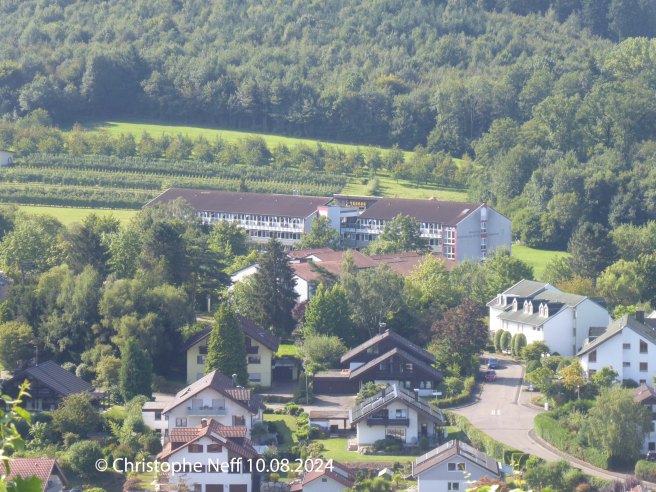
Blick vöm Köpfle -Plauelrain auf die Mediclin Staufenburg in Durbach, Vue depuis le Köpfle -Plauelrain sur la Mediclin Staufenburg à Durbach, © Christophe Neff 10.08.2024

Mais peut être les souvenirs restants de ces trois semaines sont mes pérégrinations vers la Linde, une auberge familiale & restaurant avec une très bonne cuisine badoise. Ici on trouve sur la même carte les classiques de la cuisine badoise ainsi que l’infatigable Wurstsalat –  et la patronne parle  couramment le français. Les balades à travers les vignes et forêts de Durbach et mes repas dans la « Linde » m’ont permis de m’échapper de cette atmosphère étrange de clinique de réadaptions, –  où les souvenirs de la montagne magique ne sont jamais loin. Et pour finir, naturellement réellement gravé dans mes souvenirs de ces trois semaines à Durbach la mémoire des images de la chevauche du cheval d’argent et de sa cavalière Morgane Suquart sur la Seine pendant la ceremonie d’ouverture de Jeux olympiques de Paris 2024. Dommage qu’on ne trouve pas d’article wikipedia sur ce fabuleux cheval d’argent créé par l’atelier de design Atelier Blam à Nantes. Inoubliables aussi l’hymne à l’amour de Céline Dion depuis le premier étage de la Tour Eiffel ! Et aussi la danse d’Aya Nakamura avec la Garde républicaine !

Je suis donc de retour à Grünstadt, les martinets se sont envolée vers le sud, et la France est toujours en attenante d’un nouveau premier ministre. La couverture du nouveau spiegel nous annonce les débuts d’un nouveau fascisme « wie Faschismus beginnt (comment débute le fascisme )» – et oui, comme je l’avais déjà écrit au début de l’année « nous risquons de voir Donald Trump gagner les élections présidentielles aux Etats-Unis, l’AFD au chevet du pouvoir régionale en Allemagne de l’Est,   et ne parlons pas de l’Ukraine où je crains le pire ! Un Ministre-président Björn Höcke dans l’état fédérale de Thuringe, est peut être improbable, mais certainement pas impossible ! » Concernant les Etats-Unis, je suis devenu un peu plus optimiste, car je pense que Kamala Harris a vraiment des chances de gagner les prochaines élections présidentielles aux Etats-Unis. Disons que je l’espère qu’elle gagne ces élections tellement décisives ! Une victoire de Donald Trump serait une catastrophe pour les Etats-Unis, un véritable désastre pour le Monde libre, – et il faut toujours le rappeler que nous étions déjà témoins d’un essai d’un coup de état fasciste aux Etats-Unis, c’était le 6 janvier 2021[4]. Je me suis donc mis à suivre le groupe « Kamala Harris for President News & Organizing » sur Mastodon !

Je finis ces lignes, il pleut à Grünstadt ! Par mes lectures matinale du Monde, j’aprends la mort de Alain Delon. Je pense à ses films, « il gattopardo », « Rocco e i suoi fratelli » inoubliables et je pense aussi à Romy Schneider, à la chanson « paroles, paroles » enregistrée avec Dalida !

J’aurais aimé de partir avec les Martinets vers le Sud, – me reposer quelques jours fin août à Port Leucate. Port Leucate est un pays de Martinets, – on y retrouve des véritables colonies de Martinet pale[5]. Mais les bains de mer me sont formellement interdits pendant trois mois. Je tacherai donc de descendre à Port Leucate début octobre, – les martinets seront encore sur la place, d’ailleurs il arrive qu’ils passent parfois les mois d’hiver à Port Leucate, et en Octobre je pourrais de nouveau profiter d’un bain de mer, car un peut encore très bien se baigner à Port Leucate en Octobre !

Bibliographie

Elkaim, Olivia (2023): Fille de Tunis. Paris, © Éditions Stock, 2023 ISBN 978-2-234-09192-4

Mann, Thomas ( 2010) : Der Zauberberg. Roman In der Textfassung der Großen kommentierten Frankfurter Ausgabe (GKFA ) Mit Daten zu Leben und Werk. © S. Fischer Verlag GmbH, Frankfurt am Main 2010, Fischer Ebooks, ISBN 978-3-10-400300-9

Morgenthaler, Simone (2023): Sur la route avec Tante Jeanne. © La Nuée Bleu/EBRA Éditions Strasbourg, 2024, ISBN 978-2-7165-0957-2

Langenbacher, Elmar (2020) : Mein Licht. Meine Stille.  Der Kinzigtäler Jacobsweg.  Quer duch den Schwarzwald – eine Reisereportage mit Stille. Überarbeitete Neuauflage incl. Nachwort. © Elmar Langenbacher, Offenburg 2. Auflage 2020, Elmar Langenbacher Verlag Hornberg im Schwarzwald, ISBN 978-3-98214753-6

Rieger, Annette Maria (  2023  ): Der Walder vom Schwarzwald. Erinnerungen an den rebellischen Förster Walter Trefz. © Alfred Kröner Verlag Stuttgart, I. Auflage in der Edition Edition Klöpfer, Alfred Kröner Verlag. ISBN 978-3-520-76905-3

Photos: toutes © Christophe Neff 28.07.2024 & 10.08.2024

Christophe Neff, Durbach/Grünstadt Aout 2024


[1][1] A Grünstadt on retrouve principalement le Martinet noire (Apus apus) de debut Mai à debut Aout !

[2] On retrouve mes observations naturaliste de cette periode ici sur le projet « Durbach/Ortenau etc. Juli – August 2024  »  dans l’ inaturaliste »

[3] Voir par example « Blognotice 02.06.2024 : « La promesse » d’Anne Lauvergeon » et « Blognotice 06.07.2024: veille du deuxième tour des élections législatives 2024 » et « Erinnerungen  und Gedankenfetzen zu Martin Walsers autobiographischem Roman „ein springender Brunnen“ ».

[4] « “Currently we are witnessing a fascist coup d’état attempt in Washington” were the words I published on my Facebook wall while observing the storming the United States Capitol on Wednesday the 6 January 2021 on CNN. » écrit dans « Witnessed from Grünstadt: The storm of the United States Capitol on Epiphany 2021 »

[5] Une des mes observations sonore du Martinet pale a Port Leucate du 14. September 2023 sur inaturaliste !

L’année 2023 sur le blog paysages – une rétrospective/eine Rückschau auf das Jahr 2023 im Paysagesblog

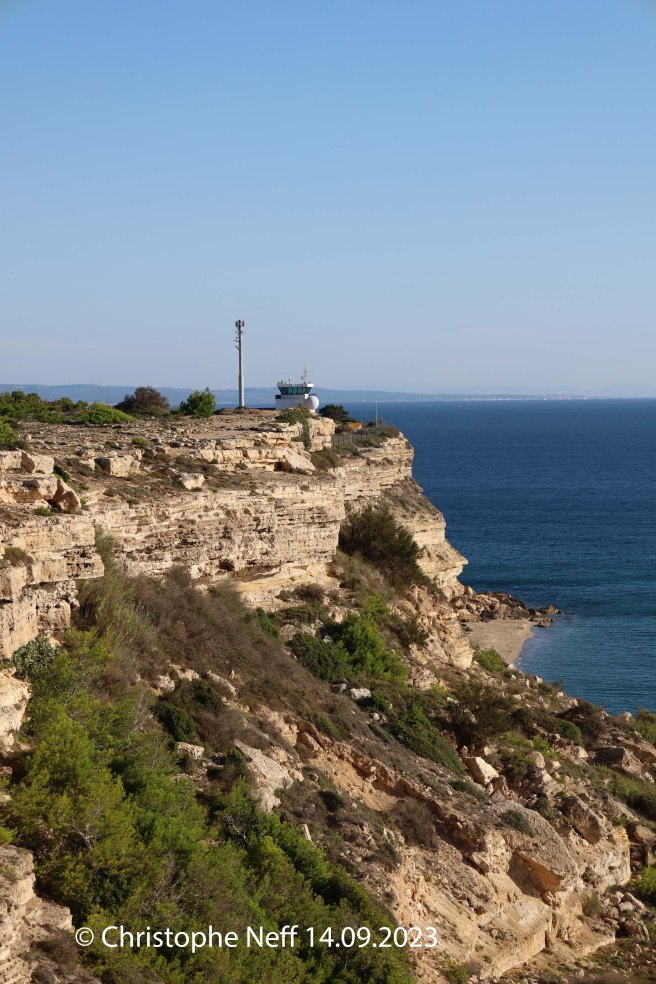
© Christophe Neff 14.09.2023, Vue sur le Cap Leucate, certainement un des lieux les plus arides de la France continentale en 2023/ Blick auf das Cap Leucate, sicherlich einer der trockensten Orte auf dem französischen Festland im Jahr 2023

Comme les années précédentes[1], je publie une petite rétrospective de l’année 2023 présentant les billets les plus lus durant l’année 2023. Vue que le blog paysages reçoit de plus en plus de lecteurs allemands – (voir tab 2) – cette fois si dans une notice bilingue franco-allemand. Plus de 90 % des lecteurs des paysages en 2023 provenait de L’Allemagne, des Etats-Unis, de la France et du  Canada. 62 % des lecteurs de paysages provenaient d’Allemagne. Les 10 articles les plus lus (ou les plus visitées ou les plus cliquées – qui sait ?) de l’année 2023 se retrouvent dans le Tableau 1.

L’évènement qui m’a certainement très marqué fut le massacre commis par le Hamas le 07. Octobre 2023 en terre d’Israël, – évènement dont je parle dans un billet daté 17 Octobre 2023 «Souvenirs des chants d’Israël, « La Caravane des Cavaliers  (Chayreth Harochvim) »  , – mais qu’on retrouve pas dans le tableau suivant – et plus récemment dans la notice daté 04.01.2024 « Paysages: Retour sur le 07 octobre 2023 –  „Stand with Israel!“ ».

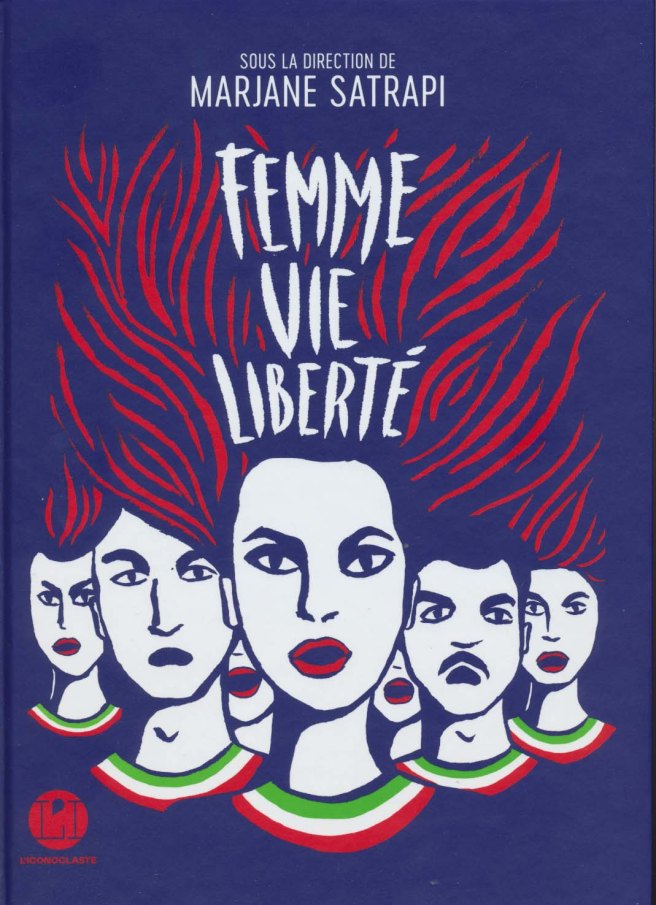
Je me suis réjoui de l’attribution du prix Sakharov à Mahsa Amini et au mouvement des femmes en Iran –  Femme, Vie, Liberté de façon posthume durant l’automne 2023! J’étais très ému écoutant le magnifique discours des enfants de Narges Mohammadi pendant la cérémonie de l’attribution du prix Nobel de la paix 2023 à Oslo (en francais)[2] – et pendant que j’écris ce lignes – je sais bien que Narges Mohammadi croupit encore dans une prison iranienne  – espérons que le monde n’oublie pas le terrible sort de Narges Mohammadi et des femmes iraniennes !

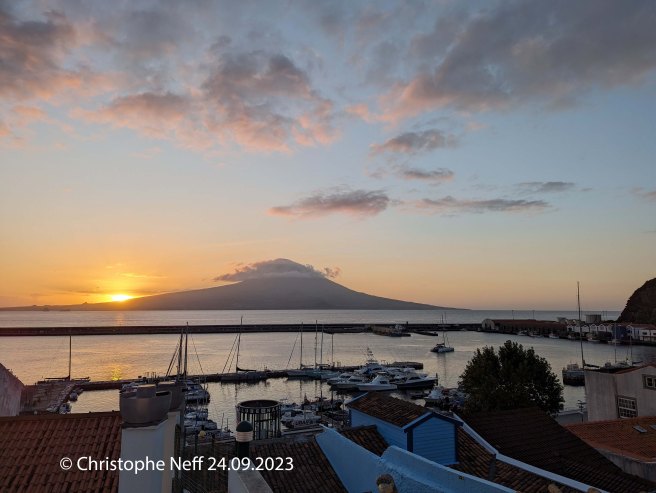
© Christophe Neff 24.09.2023, Vue sur Pico depuis Horta/Blick von Horta auf Pico

Au niveau plus personnel, ce fut mon voyage d’étude aux Açores  en Septembre 2023 qui m’a beaucoup « ému », même si jusque à présent ce voyage de recherche n’a pas (encore) laissé des traces sur paysages – et la publication de mon petite chapitre personnel dans un livre de témoignage sur la fin de la deuxième guerre mondiale à Bad Saulgau[3].

L’année 2024 s’annonce, comme je l’aie déjà décrit dans billet publie fin décembre 2023, – comme l’année des « tous les risques » géopolitique – nous risquons de voir Donald Trump gagner les élections présidentielles aux Etats-Unis, l’AFD au chevet du pouvoir régionale en Allemagne de l’Est,   et ne parlons pas de l’Ukraine où je crains le pire ! Un Ministre-président Björn Höcke dans l’état fédérale de Thuringe, est peut être improbable, mais certainement pas impossible !

Les changements climatiques risquent, la crise climatique risque,  de nous atteindre une fois de plus de plein fouet en 2024. Je suis inscrite sur les listes électorales de Leucate dans l’Aude. La station météorologique du Cap Leucate a reçu en 2023 213,7 mm de précipitons[4]. Un record négative absolu… ces conditions climatiques frôlent déjà le semi-aride ! Et ce n’est pas seulement Leucate que cette sècheresse historique concerne, c’est toute la plaine du Roussillon dans les Pyrénées-Orientales qui subit les conséquences des aléas climatiques. La crise climatique est arrivé en France, – mais cela apparemment n’intéresse pas grand monde, – sauf les vignerons et agriculteurs de ces petites régions côtières le Narbonnais, le Leucatois et le Roussillon entre Narbonne, Perpignan et la frontière espagnole !

L’année 2024 vient de débuter, j’espère que je pourrais enfin entamer ma lecture du roman de Vasilli Grossman « Pour une juste cause » !

Rang 2023Rang 2022Titre/Titel%
11Encore une déception avec le Monde – La suppression du format PDF du journal numérique du Monde4,69
28Blognotice 24.02.2022 : les troupes du Tsar Poutine attaque l’Ukraine3,22
3Le Cartographe des absences / O Mapeador de Ausências2,22
47Souvenirs de vingt ans de voyage de recherche à Capelo (Île de Faial/Açores)2,17
531949 – l‘incendie meurtrier dans la Forêt des Landes2,13
620I. Un blog sur les paysages : un petit début – ou quelle langue choisir ?2,04
7Au jardin avec le pasteur Oberlin  – sur les traces de Jean Fréderic Oberlin 1,58
816Erinnerungen an die „märklinModerne“1,51
9Ein persönlicher Rückblick auf sechzig Jahre Élysée-Vertrag1,49
106Blognotiz 13.03.2022: Erinnerungen an eine Bahnreise nach Saulgau im März 20101,28
Tableau 1/Tabelle 1 : Les 10 articles les plus lus sur paysages en 2023/ Die 10 meistgelesenen Artikel im Paysagesblog im Jahre 2023

RangPays/Land%
1Allemagne/Deutschland62,35
2USA18,51
3France/Frankreich11,46
4Canada1,86
5Suisse/Schweiz0,82
6Portugal0,77
7Tunisie0,66
8Pays-Bas/Niederlande0,36
9UK0,30
10Belgique0,30
Tableau 2 : Provenance de géographique des lecteurs/lectrices  de paysages/ Geographische Herkunft der Leser/innen des paysagesblog

Wie in den vergangenen Jahren[5] veröffentliche ich einen kleinen Jahresrückblick mit den meistgelesenen Beiträgen des Paysagesblog des Jahres 2023. Angesichts der Tatsache, dass der paysagesblog immer mehr deutsche Leser erhält – (siehe Tab 2) – diesmal in einem zweisprachigen deutsch-französischen Blogpost. Mehr als 90 Prozent der Leser von paysages im Jahr 2023 kamen aus Deutschland, den USA, Frankreich und Kanada. 62 Prozent der Leser des paysagesblog kamen aus Deutschland. Die 10 meistgelesenen Artikel des Jahres 2023 (oder die meistbesuchten oder meistgeklickten – wer weiß das schon?) finden sich in Tabelle 1.

Das Ereignis, das mich sicherlich am meisten gezeichnet hat, war das Massaker, das die Hamas am 07. Oktober 2023 im Land Israel verübte , – dem  ich dem Blogbeitrag  vom 17. Oktober 2023 „Souvenirs des chants d’Israël, « La Caravane des Cavaliers  (Chayreth Harochvim) »  widmete und welcher sich nicht in der Tabelle befindet, weiterhin die Blognotiz vom  04.01.2024 „Paysages: Retour sur le 07 octobre 2023 –  „Stand with Israel!“ » die ich zu Beginn dieses Jahres verfasste

Ich habe mich sehr gefreut, dass Mahsa Amini und die Frauenbewegung im Iran – Frau, Leben, Freiheit im Herbst 2023 posthum den Sacharow-Preis erhalten haben. Ich war sehr bewegt, als ich die sehr beeindruckende Rede der Kinder von Narges Mohammadi bei der Verleihung des Friedensnobelpreises 2023 in Oslo hörte (die Kinder von Narges Mohammadi die in Frankreich leben, hielten die Rede auf Französisch und teilweise in Persisch)[6] – und während ich diese Zeilen schreibe – weiß ich, dass Narges Mohammadi immer noch in einem iranischen Gefängnis leidet – und man kann nur hoffen, dass die Welt das schreckliche Schicksal von Narges Mohammadi und den iranischen Frauen nicht vergisst.

Auf einer mehr persönlicheren Ebene war es meine Studienreise/Exkursion auf die Azoren im September 2023, die mich sehr „bewegt“ hat, auch wenn diese Forschungsreise bis jetzt (noch) keine Spuren auf dem paysagesblog hinterlassen hat – und die Veröffentlichung meines kleinen persönlichen Erinnerungskapitels in einem Zeitzeugenbuch über das Ende des Zweiten Weltkriegs in Bad Saulgau[7].

Das Jahr 2024 kündigt sich, wie ich es bereits in meinem Ende Dezember 2023 veröffentlichten Blogbeitrag beschrieben habe, als das Jahr der „aller geopolitischen Risiken“ an – wir riskieren, dass Donald Trump die Präsidentschaftswahlen in den USA gewinnt, die AFD in den ostdeutschen Bundesländern an der Schwelle zur Macht steht, und ganz zu schweigen von der Ukraine, wo ich das Schlimmste befürchte! Das Björn Höcke zum Ministerpräsidenten von Thüringen gewählt wird ist vielleicht unwahrscheinlich, aber bestimmt nicht unmöglich!

Der Klimawandel droht, die Klimakrise droht, uns im Jahr 2024 erneut mit voller Wucht zu treffen. Ich bin in den Wählerlisten von Leucate im Departement Aude eingetragen. Die Wetterstation Cap Leucate erhielt im Jahr 2023 213,7 mm Niederschlag[8]. Ein absoluter Negativrekord … diese klimatischen Bedingungen grenzen bereits an semiaride Verhältnisse! Und es ist nicht nur das Küstenstädchten Leucate, welches unter dieser historische Trockenheit leidet, sondern die gesamte Ebene des Roussillon in den Pyrénées-Orientales, die unter den Folgen der klimatischen Unwägbarkeiten leidet. Die Klimakrise ist in Frankreich angekommen, – aber das interessiert offenbar kaum jemanden in Frankreich, – außer den Winzern und Landwirten dieser kleinen Küstenregionen des Narbonnais, des Leucatois und des Roussillon zwischen Narbonne, Perpignan und der spanischen Grenze!

Das Jahr 2024 hat gerade begonnen, und ich hoffe, dass ich endlich die Lektüre von Vasilli Grossmans großen Roman „Pour une juste cause[9]“ beenden kann!

Photos: © Christophe Neff 14.09.2023, Vue sur le Cap Leucate, certainement un des lieux les plus arides de la France continentale en 2023/ Blick auf das Cap Leucate, sicherlich einer der trockensten Orte auf dem französischen Festland im Jahr 2023; © Christophe Neff 24.09.2023, Vue sur Pico depuis Horta/Blick von Horta auf Pico; Scan de la couverture du livre « Femme, Vie, Liberté ».

Bibliographie :

Grossman, Vasilli; Jurgenson, Luba (trad.) : Pour une juste cause. Traduit du russe par Luba Jurgenson.. Édition  établie et prefacée par Luba Jurgenson. Postface de Robert Hugh Chandler. Paris, 2023. За правое дело (For a just cause), © Ekaterina Vasilyevna Korotkova et Yelena Fedoronvna Kozhichkina, 2019, Postface © Robert Hugh Chandler, pour la traduction. ISBN 978-2-7021-8035-8

Neff, C. (2023): Der Schramm, der Bahnhof und der Krieg. In: Scheck, Conny; Gelder, Maria Margarete (Hrsg): Aus dem Grau der Kriegszeit. Geschichten hinter der Geschichte. Spuren Lebendig Gemacht, Band III, Bad Saulgau Mai 2023, S. 252 – 259. (Ein PDF – Sonderdruck des Buchbeitrages kann in der KITOPEN Bibliothek heruntergeladen werden DOI: 10.5445/IR/1000159193)

Satrapi, Marjane (Ed.)(2023): Femme, Vie, Liberté. Avoir vingt ans en Iran et Mourir pour les droits de femmes. Sous la direction de Marjane Satrapi. ©  L’Iconoclaste, Paris 2023, ISBN 978-2-37880-378-0

Christophe Neff, 14.01.2024 (publié/veröffentlicht 15.01.2024)


[1] Voir aussi : L’année 2022 sur le blog paysages – une rétrospective

[2] Voir la vidéo de la cérémonie d’attribution du Prix de Nobel de la Paix 2023 à Narges Mohammadi sur le site de la fondation Nobel « Narges Mohammadi Nobel Lecture »  et aussi ici sur Youtube !

[3] Voir aussi „„Net schon wieder Ulm“ : Über die Buchpräsentation „Aus dem Grau der Kriegszeit – Geschichten hinter der Geschichte“ in der Bad Saulgauer Stadthalle am Donnerstag den 25.5.2023

[4] Voir ici: https://www.infoclimat.fr/climatologie/annee/2023/leucate/valeurs/07666.html

[5] Siehe auch « L’année 2022 sur le blog paysages – une rétrospective » sowie „Rückblick auf das Jahr 2022 im Paysagesblog“.

[6] Siehe auch hier das Video der Zeremonie zur Verleihung des Friedensnobelpreises 2023 an Narges Mohammadi auf der Website der Nobel-Stiftung „Narges Mohammadi Nobel Lecture“ und auch hier auf Youtube !

[7] Siehe auch: „„Net schon wieder Ulm“ : Über die Buchpräsentation „Aus dem Grau der Kriegszeit – Geschichten hinter der Geschichte“ in der Bad Saulgauer Stadthalle am Donnerstag den 25.5.2023

[8] Siehe: https://www.infoclimat.fr/climatologie/annee/2023/leucate/valeurs/07666.html

[9] Im Deutschland bzw. auf Deutsch ist dieser Roman von V. Grossmann u.a. unter den Titeln „Wende an der Wolga“ bzw. später auch unter dem Namen „Stalingrad“ veröffentlicht worden

Ein persönlicher Rückblick auf sechzig Jahre Élysée-Vertrag

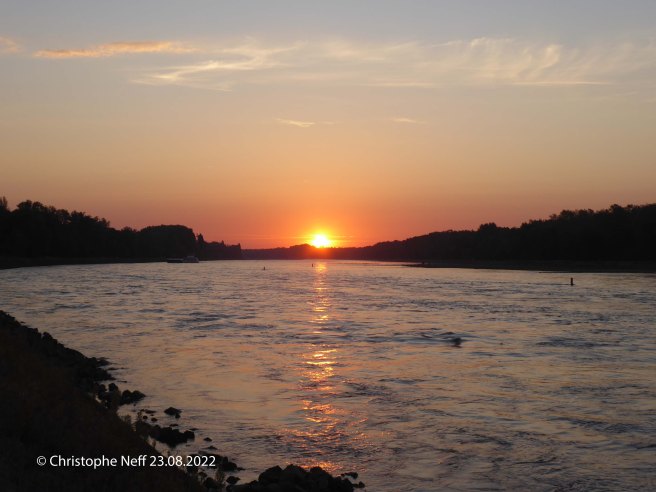
l’aube franco-allemand sur le Rhin à Lauterbourg/ deutsch-französische Morgendämmerung auf dem Rhein bei Lauterbourg,  © Christophe Neff 23.08.2022

Am 22 Januar 2023 wurde der der deutsch-französische Freundschaftsvertrag, der sogenannte Élysée-Vertrag, sechzig Jahre alt. Zum fünfzigsten Jahrestag des Élysée-Vertrags hatte ich einen längeren auf Französisch verfassten Beitrag namens „Blognotice 22.01.2013: pensées personnelles franco-allemandes sur le cinquantième anniversaire du Traité de l’Elysée“ auf paysages gepostet. Seitdem sind nun über 10 Jahre vergangen, – und der damalige, sehr persönliche Beitrag hat nichts von seiner Aktualität verloren. In diesen zehn Jahren haben sich, nach meinem Empfinden,   Frankreich und Deutschland eher voneinander entfernt als angenähert. In einem Rückblick auf die Zeit als Paysages noch ein Le Monde.fr Abonnentenblog war schrieb ich im April 2019 folgendes: „Nach zehn Jahren paysages auf Le Blogs le Monde – und paysages wollte zumindest in den Anfängen auch ein deutsch französischer Blog sein – muss ich feststellen, dass der Graben der Frankreich und Deutschland trennt, trotz aller Sonntagsreden über die wichtige, gar lebensnotwendige Bedeutung der deutsch-französischen Beziehungen, noch nie so groß war wie heute.“ Dem ist eigentlich nichts hinzuzufügen – außer vielleicht, dass ich das Gefühl habe, dass der „Graben“ der Frankreich und Deutschland trennt, immer größer wird. Es ist natürlich nicht nur ein gefühlter Graben, – die wirtschaftliche „Schere“ zwischen Deutschland und Frankreich wird immer breiter. Das deutsche „BIP“ ist dem französischen „BIP“ regelrecht enteilt.  Aber natürlich hat das Ganze auch seinen Preis. Der deutsche „Wirtschaftserfolg beruht(e) u.a. auf sehr preiswerter Energie aus Russland, – einem „hemmungslosen“ Handel mit China, – und auch der schon fast sträflichen Vernachlässigung der öffentlichen Infrastruktur und Daseinsvorsorge in Deutschland. Frankreich hat hingegen eine funktionierende schlagkräftige Armee, einen sehr gut professionellen Zivilschutz, der sich jedes Jahr bei Waldbränden und Hochwasserereignissen bewährt. Nur beim Eisenbahnwesen, wenn man vom TGV-Netz absieht, sieht es in Frankreich erheblich schlechter aus als in Deutschland. Es gibt ganze Landstriche ohne funktionierende Eisenbahnen in Frankreich. Darüber verfasste ich vor einigen Jahren den Artikel „Streckenbeobachtungen in der „France périphérique“ – ein geographischer Kommentar zur ersten Runde der Präsidentschaftswahlen 2017 in Frankreich[1]“ – und seitdem hat sich am Zustand des französischen Eisenbahnnetzes im ländlichen Raum nichts wesentliches verändert. Wir haben in Deutschland ein hyperkompetitives Wissenschaftssystem, ein sehr auf „Effizienz“ getrimmtes System, das vor allem zu Lasten von Doktoranden und Post-Docs geht, von denen nur die wenigsten die Chance haben jemals eine feste Stelle in der deutschen Forschungs – und Universitätslandschaft zu bekommen.  In der Öffentlichkeit ist wohl relativ bekannt,  dass es deutsche Wissenschaftler vor allem in die USA, Kanada und die Schweiz zieht,  wobei es relativ wenige belastbare Zahlen dazu gibt. Weit weniger ist in Deutschland bekannt, dass es zumindest in den Natur- und Umweltwissenschaften auch immer mehr Wissenschaftler nach Frankreich zieht. Der Grund ist einfach – auch wenn französische Wissenschaftler im Vergleich zu Deutschland (und anderen Ländern) relativ wenig verdienen, so gibt es doch noch (erheblich) mehr Dauerstellen im französischen Wissenschaftsbetrieb als in Deutschland. Es würde sich bestimmt lohnen, die „Auswanderung & Abwanderung“ aus der deutschen Wissenschaftslandschaft tiefergehend zu analysieren.

So wie sich in den letzten Jahren ein deutliches Wohlstandgefälle zwischen Deutschland und Frankreich entwickelt hat,  so haben sich denn wohl die beiden Ländern kulturell mehr und mehr auseinanderentwickelt. Das Wohlstandgefälle zwischen beiden Ländern hat bestimmt etwas damit zu tun, erklärt aber letztlich auch nicht alles. Die Lebenswirklichkeiten in beiden Ländern haben sich wohl auch eher auseinander als aufeinander zu entwickelt. Dennoch möchte ich betonen, dass Deutschland zwar wirtschaftlich Frankreich überholt hat, aber ich glaube, dass Frankreich sowohl gegenüber „externen Schocks“, als auch gegenüber „Natur- und Umweltkatastrophen“ erheblich resilienter ist als Deutschland.

Persönlich hatte ich mir erhofft, dass der Krieg in der Ukraine vielleicht dazu führen würde, dass Deutschland und Frankreich intensiver miteinander kooperieren würden, aber letztlich ist da bisher nicht viel geschehen. Angesichts dieser existentiellen Krise mitten in Europa, wäre es mehr als wünschenswert, wenn Paris und Berlin wieder mehr zusammenfinden würden, – so wie einst Helmut Schmidt und Valéry Giscard d’Estaing oder Helmut Kohl und François Mitterrand.

Ja, und was das Sprachenlernen betrifft, – in Deutschland wäre schon sehr viel gewonnen, wenn man aufhören würde, die romanischen Sprachen – meist Französisch versus Spanisch – gegeneinander ausspielen. Ich rede schon gar nicht mehr vom Latein. Eine gut organisierte Schule, mit motivierten Lehrern, kann selbstverständlich ihren Schülern Englisch, Französisch, Spanisch und ggf. noch Latein, oder gar Portugiesisch oder Russisch beibringen. Das lässt sich leisten, wenn man es denn will. Wenn man es denn wirklich will, dann sollte man natürlich auch dafür die Ressourcen bereitstellen! Aber angesichts des sich ankündigenden Lehrermangels in Deutschland, kann man von solch einer „multilingualen Schule“ bzw. „multilingualen Gymnasium“ wohl nur träumen! Eine solche Schule würde bestimmt weit mehr für die sogenannte Deutsch-Französische Freundschaft, für die europäische Idee leisten, als die vielen salbungsvollen „Sonntagsreden“ die man anlässlich des 60 Jubiläum des Élysée-Vertrag beiderseits des Rheins hören konnte. Reden und Beiträge die wahrscheinlich, jetzt wo ich diese Zeilen niederschreibe, längst schon wieder „vergessen“ sind!

Photo: l’aube franco-allemand sur le Rhin à Lauterbourg/ deutsch-französische Morgendämmerung auf dem Rhein bei Lauterbourg,  © Christophe Neff 23.08.2022

Christophe Neff, Grünstadt 05.02.2023


[1] In leicht veränderter Fassung auf Französisch unter dem Titel „Blognotice 01.05.2017: « Les fleurs qui poussent à travers les rails de la France périphérique » veröffentlicht. Tatsächlich gehörte dieser Blogbeitrag eine längere Zeitlang zu den am häufigsten konsultierten Blogbeiträgen in Paysages.

Witnessed from Grünstadt: The storm of the United States Capitol on Epiphany 2021

Currently we are witnessing a fascist coup d’état attempt in Washington” were the words I published on my Facebook wall while observing the storming the United States Capitol on Wednesday the 6 January 2021 on CNN. Epiphany is a holyday in Baden – Württemberg, and as I work in Karlsruhe at the KIT, this was also a holyday for me, even if a live in Grünstadt in Rhineland-Palatinate where Epiphany is not a holyday. In former days when my children were younger I used this holyday, or the days after this holyday to drive to France to buy some “galettes des rois” for them. But now they are older, and they are not more interested in “galettes des rois”, this old French tradition of choosing the King or Queen of a day on Epiphany. I used the holyday to write my traditional blog retrospective  “Rétrospective sur le blog paysages en 2021[1]” but then I received a breakings news mail from the NYT  on about 20:45 German-Time “              The New York Times – BREAKING NEWS : Vice President Mike Pence was rushed from the Senate chamber and the vote certification was halted as pro-Trump protesters stormed Capitol Hill” – and then I began to witness this historical moment on CNN – and didn’t finished my blog retrospective post, post which still waits to be finished.

I was neither astonished nor shocked by the images transmitted by CNN because for me it seems to be clear that was something was in progress with the “Trumpistes”. At least when I read the opinion piece  “All 10 living former defense secretaries: Involving the military in election disputes would cross into dangerous territory” published by the Washington Post on the 3 January I was convinced that “Trump and the Trumpistes” were on the way to sustainably disrupt the transition process. But even before that I was convinced that the transition phase could be at least chaotic – in a blogarticle posted in paysages on 3. November I wrote “Et même si Biden gagnait, je pense que la transition des pouvoirs sera au moins chaotique, personnellement je crains même le pire pour les Etats-Unis. Les « Trumpistes » auront certainement du mal à accepter une défaite électorale. (translation = And even if Biden won, I think the transition of power will be at least chaotic, personally I fear even worse for the United States. The „Trumpists“ will certainly have a hard time accepting an electoral defeat. [2]”.

But concerning the inability of the security authorities, the police, not to have prevented the storming of the Capitol, have nevertheless more than shocked me. If the French Police during the Yellow vests movement in France in Winter 2018/19 would have reacted in this amateurish way as the security forces during the Capitol Storm, France would now be governed by a national-bolschevist people’s committee or a national-bolschevist dictator or something similar.

In my Facebook post on my timeline I used the Book cover of Madeleine Albright “Fascism – a warning”. I read the Book in summer 2018 and I found this book was a very comprehensive description of the rise of the fascism in Europe. Seeing the “trumpist Mob storming the Capitol” recalls me the chapters were Albright descriped the  March on Rome of Benito Mussolini and his Black Shirts! For me the Book was also something like a wakeup call concerning the Trump presidency!

Some may view this Book and its Title as Alarmist. Good. We should be awake to assault on democratic values that has gathered strength in many countries abroad that is dividing America at home. The temptation is powerful to close our eyes and wait for the worst to pass, but history tells us that for freedom to survive, it must be defended, and if lies are to stop, they must be exposed (Albright (2018:252)”. At least not so many people have been so impressed by these word, which I read in 2018, – but after all what read, and of course I am reader – heard and see from the Trump presidency – I was convinced that this man would be capable of the worst.

That’s the way I witnessed the “Storm on the Capitol” on Wednesday the 6 January, the day of the Epiphany. Not so astonished, but shocked by the unpreparedness and amateurism of the security forces of the Capitol. The event recalled me a part of the books I have read during my life time concerning fascism and dictatorial power took over[3], and more recently the book “Fascism – a warning” written and published by Madeleine Albright in 2018.

Writing down this word some days after these dramatic events, I hope that this nightmare is over on January the 20 2021. Seen from Grünstadt, the town where I live, this seems to be the most dramatic political crisis for the United States of America since the Amercian Civil War.

Books and other sources:

Albright, Madeleine; Woodward, Bill (2018): Fascism a warning (with Bill Woodward). London, 2018. ISBN 978-0-00-828227-1

Applebaum, Anne (2020) : Twilight of Democracy. The Seductive Lure of Authoritarianism. New York. ISBN 978-0-385-54580-8

Guilluy, Christophe (2010) : Fractures françaises. Paris, ( François Bourin Editeur), ISBN 978-2-84941-201-5

Neff, C. (2012): Blognotice 5.5.2012 : – la géographie le grand gagnant du scrutin des présidentielles 2012. In : Paysages: paysages et livres – Landschaften und Bücher – Landscapes and Books. 12.05.2012

Neff, C. (2020):   Blognotice 02.11.2020: Donald Trump peut – il encore gagner ? In : Paysages: paysages et livres – Landschaften und Bücher – Landscapes and Books. 02.11.2020

Photo/Screenshot: Authors Facebook TimeLine, 06.01.2021 21:25 Berlin Time (GMT +01:00).

Christophe Neff, written and published in Grünstadt, Saturday 09.01.2021


[1] The last retrospective was “Rétrospective sur le blog paysages en 2019 ». The paysages retrospective of 2020 will be published with some delay !

[2] See the whole article (written in French) « Blognotice 02.11.2020: Donald Trump peut – il encore gagner ? »

[3] I read so many booktitles concerning this topic that’s quasi impossible to name them all. Currently  Anne Applebaum‘s “ Twilight of Democracy   “ is on my reading desk. A book which a the first glance has nothing to do with the US is  “ la France peripherique”   (see also “Blognotice 5.5.2012 : – la géographie le grand gagnant du scrutin des présidentielles 2012 “)  written by the French geographer Christophe Guilluy, –    a similar book as Guilluy wrote it for “peripherical France” focusing on “middle class decline” in rural and periphical America would perhaps also light up why so many Americans have still given their vote to Donald Trump in the last presidential election.

Blognotice 02.11.2020: Donald Trump peut – il encore gagner ?

Naturellement Donald Trump peut encore gagner les élections présidentielles du 3. Novembre 2020. J’avais prédit la première victoire de Trump en 2016 dans un post Facebook écrit en allemand[1]. Je pense qu’il pourrait refaire l’exploit et aussi gagner l’élection de 2020. Mais il faut dire que je suis beaucoup moins sûr qu’en 2016. Après tout Joe Biden semble dominer les sondages, même dans la plupart de swings states il semble avoir une avance sur Trump[2]. Mais à vrai dire je n’ai jusqu’à présent pas encore découvert un pronostic convaincant au niveau des sièges du « Collège électoral des États-Unis ». Une très grande partie de la presse écrite allemande semble plus au moins convaincue que Biden remporte les élections. On semble plutôt se demander si Trump était vraiment prêt à accepter une défaite électorale[3]. Par contre il faut le noter que le Monde a publié un article « Election présidentielle américaine : pourquoi Donald Trump a toujours des chances d’être réélu, malgré des sondages défavorables [4]» écrit par Gilles Paris et qui démontre que néanmoins Donald Trump peut encore créer la surprise et gagner les élections présidentielles.

C’est peut être aussi la lecture de l’ouvrage « Amériques Années Trump » coécrite par Jérome Cartillier et Gilles Paris qui m’a persuadé qu’en dépit des sondages favorables à Biden, Trump pourrait encore gagner la partie. Dans ce contexte ce fut certainement aussi la lecture du reportage « Il y a autant de chances que je vote Biden que Mickey Mouse» : avant la présidentielle, retour en Amérique profonde [5]» écrit par Arnaud Leparmentier – un retour sur les terres d’un séjour linguiste dans le « Deep America ». Ou le roman « Aus und davon (Finir et partir) » de Katharina Hahn qui contient aussi la description d’un voyage de Stuttgart à Meadville en Pennsylvanie. Naturellement je sais que les sondages semblent prédire la victoire de Biden. Dans cette petite contribution de blog j’aimerais simplement mettre en garde contre un excès d’optimisme, Biden est loin d’avoir gagné les élections. Et même si Biden gagnait, je pense que la transition des pouvoirs sera au moins chaotique, personnellement je crains même le pire pour les Etats-Unis. Les « Trumpistes » auront certainement du mal à accepter une défaite électorale.

On peut toujours se demander pourquoi en 2016 j’avais été si sûr que Trump gagnerait ? En fait ceci mériterait un billet entier, peut-être même plusieurs. En fait je n’ai jamais mis mes pieds aux Etats-Unis, mais depuis mon enfance j’avais toujours ressenti une fascination envers ce pays si lointain et si proche, et j’ai déjà depuis dévoré des milliers de pages de lectures sur les hommes et paysages des U.S.A. Durant l’été 2016 j’ai effectué un voyage virtuel à travers les paysages des Etats Unis, le « steel belt » de mes années étudiantes avait disparu, – on parlait  maintenant du « rust belt ». Les « Okies » des « Raisins de la colère » certainement un de mes romans préfèrés, semblaient  ressurgir sur les routes de la pauvreté des ruraux des Etats-Unis[6]. A travers mes lectures je découvrais un pays maudit par la pauvreté, le désespoir, un pays déchiré par des multiples déchirures – une Amérique loin des clichés traditionnels. Je pense que cette Amérique n’a pas disparu. Si Biden gagnait, ce que j’espère profondément,  il aura un énorme défi devant lui – essayer de combler les déchirures profondes des Etats – Unis[7],[8] , ces déchirures qui en 2016 étaient en partie responsables de la victoire de Donald Trump.

Bibliographie :

Livres :

Cartillier, Jérôme ; Paris, Gilles (2020): Amérique Années Trump. Paris, Gallimard, ISBN 978-2-07-285525-2

Hahn, Anna Katharina (2020): Aus und davon. Roman. Berlin, Suhrkamp, ISBN 978-3-518-42919-8

Steinbeck, John (1997): The Grapes of Wrath. Text and Cristicism. Edited by Peter Lisca with Kevin Hearle. Viking Critical Library, Penguin, New York. ISBN 978-0-14-024775-6

Article de presse etc.:

Burns, Alexander; Martin, Jonathan (2020): Election at Hand, Biden Leads Trump in Four Key States, Poll Shows. The New York Times, Nov. 1, 2020.

Faure, Valerie (2020) : „Voyage dans les Etats désunis d’Amérique, hantés par la guerre civile“ par Valerie Faure, LeMonde.fr, 30.10.2020

Höhne, Valerie; Neukirch, Ralf; Pfister, René; Rojkov, Alexandra, Sarovic, Alexander (2020): Trump forever – USA. Ob Donald Trump die Wahl am Dienstag gewinnt – Hass und politische Zwietracht werden das Land auf Jahre hinaus lähmen“, Der Spiegel, 45, 30.10.2020, pp. 10-20.

Leparmentier, Arnaud (2020) : « Il y a autant de chances que je vote Biden que Mickey Mouse » : avant la présidentielle, retour en Amérique profonde“ par Arnaud Leparmentier », LeMonde.fr 13.10.2020 (Article réservé aux abonnés).

Neff, C. (2017) : „Rétrospectives sur le blog paysages en 2016 – les billets les plus lus de « paysages » en 2016“,   Paysages: paysages et livres – Landschaften und Bücher – Landscapes and Books.

Paris, Gilles (2020): « Election présidentielle américaine : pourquoi Donald Trump a toujours des chances d’être réélu, malgré des sondages défavorables », LeMonde.fr 28.10.2020 (Article résérve aux abonnés).

Christophe Neff, le 02.11.2020


[1] Voir aussi „Rétrospectives sur le blog paysages en 2016 – les billets les plus lus de « paysages » en 2016“.

[2] Voir aussi: „Election at Hand, Biden Leads Trump in Four Key States, Poll Shows.“ dans le NYT.

[3] Voir aussi: „Trump forever – USA. Ob Donald Trump die Wahl am Dienstag gewinnt – Hass und politische Zwietracht werden das Land auf Jahre hinaus lähmen“, Der Spiegel, 45, 30.10.2020, pp. 10 – 20.

[4] « Election présidentielle américaine : pourquoi Donald Trump a toujours des chances d’être réélu, malgré des sondages défavorables », LeMonde.fr 28.10.2020 (Article résérve aux abonnés).

[5] « « Il y a autant de chances que je vote Biden que Mickey Mouse » : avant la présidentielle, retour en Amérique profonde“ par Arnaud Leparmentier », LeMonde.fr 13.10.2020 (Article réservé aux abonnés).

[6] J’avais aussi retrace virtuellement le voyage de la famille « Joad » le long de la fameuse route 66, de l’Oklahoma  jusque en Californie en utilisant la carte « the itinerary of the Joads » édite dans l’Edition « The Grapes of Wrath. Text and Criticism. Edited by PeterLisca with Kevin Hearle (1997).

[7] Voir aussi: „Trump forever – USA. Ob Donald Trump die Wahl am Dienstag gewinnt – Hass und politische Zwietracht werden das Land auf Jahre hinaus lähmen“, Der Spiegel, 45, 30.10.2020, pp. 10 – 20.

[8] Voir aussi: „Voyage dans les Etats désunis d’Amérique, hantés par la guerre civile“ par Valerie Faure, LeMonde.fr, 30.10.2020 ((Article résérvé aux abonnés).

Blognotice 11.09.2020: Retrospective on a Facebook post concerning COVID-19 written in April 2020

I decided to publish here in paysages, the original of a Facebook post written and published during the COVID-19 lockdown in Germany on the fifth of April 2020 on Facebook.

Why open this previously private Facebook post to a wider audience?

Seen what happened since this springtime, how this pandemic diseases affected the whole world,  this text written in April 2020 could also be seen as a contemporary history document. Since April 2020 many things happened concerning the spread of COVID-19, – but in my opinion – and after having read again my own text – two important things have to be noted. The management of the COVID-19 Crisis by the Trump administration in the United State was (and is still) a complete disaster. The other point, and this seems to get much lower international media attention than the chaotic management of the COVID-19 by Trump administration, China used the attention gap provided by the worldwide COVID-19 crisis to enforce the “Hong Kong national security law”.

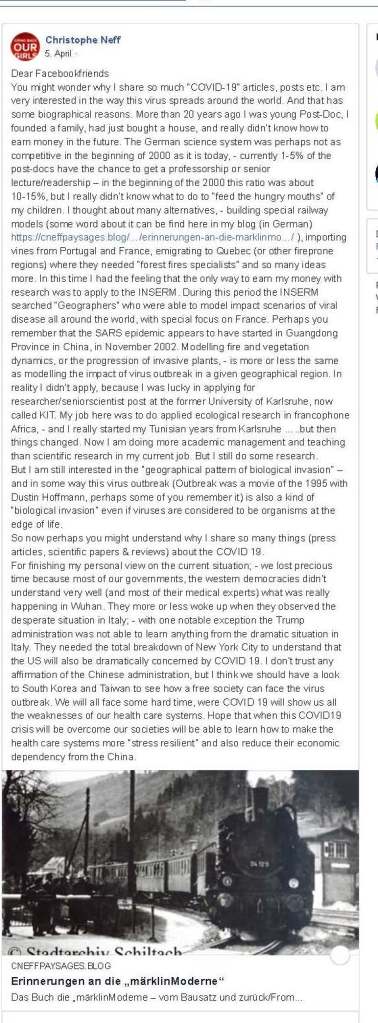
The original text of the April Facebook text is written in italic. I have also added a screenshot of the original Facebook post.

Dear Facebookfriends

You might wonder why I share so much “COVID-19” articles, posts etc. I am very interested in the way this virus spreads around the world. And that has some biographical reasons. More than 20 years ago I was young Post-Doc, I founded a family, had just bought a house, and really didn’t know how to earn money in the future. The German science system was perhaps not as competitive in the beginning of 2000 as it is today, – currently 1-5% of the post-docs have the chance to get a professorship or senior lecture/readership – in the beginning of the 2000 this ratio was about 10-15%, but I really didn’t know what to do to “feed the hungry mouths” of my children. I thought about many alternatives, – building special railway models (some word about it can be find here in my blog (in German) https://cneffpaysages.blog/2018/07/08/erinnerungen-an-die-marklinmoderne/ ), importing vines from Portugal and France, emigrating to Quebec (or other fireprone regions) where they needed “forest fires specialists” and so many ideas more. In this time I had the feeling that the only way to earn my money with research was to apply to the INSERM. During this period the INSERM searched “Geographers” who were able to model impact scenarios of viral disease all around the world, with special focus on France. Perhaps you remember that the SARS epidemic appears to have started in Guangdong Province in China, in November 2002. Modelling fire and vegetation dynamics, or the progression of invasive plants, – is more or less the same as modelling the impact of virus outbreak in a given geographical region. In reality I didn’t apply, because I was lucky in applying for researcher/seniorscientist post at the former University of Karlsruhe, now called KIT.  My job here was to do applied ecological research in francophone Africa, – and I really started my Tunisian years from Karlsruhe …..but then things changed. Now I am doing more academic management and teaching than scientific research in my current job. But I still do some research.

But I am still interested in the “geographical pattern of biological invasion” – and in some way this virus outbreak (Outbreak was a movie of the 1995 with Dustin Hoffmann, perhaps some of you remember it) is also a kind of “biological invasion” even if viruses are considered to be organisms at the edge of life.

So now perhaps you might understand why I share so many things (press articles, scientific papers & reviews) about the COVID 19.

For finishing my personal view on the current situation; – we lost precious time because most of our governments, the western democracies didn’t understand very well (and most of their medical experts) what was really happening in Wuhan. They more or less woke up when they observed the desperate situation in Italy; – with one notable exception the Trump administration was not able to learn anything from the dramatic situation in Italy. They needed the total breakdown of New York City to understand that the US will also be dramatically concerned by COVID 19. I don’t trust any affirmation of the Chinese administration, but I think we should have a look to South Korea and Taiwan to see how a free society can face the virus outbreak. We will all face some hard time, were COVID 19 will show us all the weaknesses of our health care systems. Hope that when this COVID19 crisis will be overcome our societies will be able to learn how to make the health care systems more “stress resilient” and also reduce their economic dependency from the China.

(original text = https://www.facebook.com/christophe.neff/posts/2819708018150558)

Epilogue:

As I wrote it in my last post in paysages (in French), I had the chance to participate in virtual conference concerning the geography of COVID-19 and during the preparation of my own presentation[1] I discovered a very interesting paper „Ecological and epidemiological models are both useful for SARS-CoV-2[2]“ which also treats the similarities (and differences) of ecological and epidemiological models, –  which in some way reveals to what I wrote in the Facebook text and what I did more the 25 years ago modelling vegetation dynamics and wildfire dynamics in Mediterranean ecosystems. Furthermore in preparation of these conference and my own I also read a very interesting book concerning the consequence of COVID-19 lockdown in France “En immersion : enquête sur une société confine” written by Jérome Forquet et al[3]. I don’t know if this book will be translated into English, but for all reading French, this books provides a very comprehensive approach of the French society during the COVID -19 lockdown in springtime 2020, – combining sociological, geographical and geo-medical analysis.

Sources:

Araújo, M.B., Mestre, F. & Naimi, B. Ecological and epidemiological models are both useful for SARS-CoV-2. Nat Ecol Evol (2020). https://doi.org/10.1038/s41559-020-1246-y

Fourquet, J., Gariazzo, M., Jaboulay, G., Kraus, F., Wolber, S. (2020):  En immersion : enquête sur une société confinée. Paris, Éditions du Seuil.

Christophe Neff, Port Leucate 11.09.2020


[1] Neff, C.(2020): „Persönliche Überlegung zur COVID 19 – Situation„. In: COVID-19 als Zäsur? Virtual Oralpresentation  at : Geographische Perspektiven auf Räume, Gesellschaften und Technologien in der Pandemie. 6.7 – 8.7.2020.. Online Symposium. Research Group Transient Spaces & Societies. Geographisches Institut der Leopold-Franzens-Universität Innsbruck. See also on the Webpages of the „Arbeitskreis Medizinische Geographie und Geographische Gesundheitsforschung in der Deutschen Gesellschaft für Geographie (DGfG)“. (Download of the extended Abstract (in German) here).

[2] Araújo, M.B., Mestre, F. & Naimi, B. Ecological and epidemiological models are both useful for SARS-CoV-2. Nat Ecol Evol (2020). https://doi.org/10.1038/s41559-020-1246-y

[3] Fourquet, J., Gariazzo, M., Jaboulay, G., Kraus, F., Wolber, S. (2020):  En immersion : enquête sur une société confinée. Paris, Éditions du Seuil.

Blognotice 10.11.2012: back sight on a rainy November Wednesday morning in South West Germany

Daybreak in Grünstadt: 7. November 2012, 5.50 am. local time,  raindrops were falling on the roofs of a sleepy German town. Some minutes later I turned my notebook on to get news from the results of presidential election in the U.S. The first info I got was an alert message by email from le Monde.fr – sent by le Monde.fr  at 5.21 – “   “Barack Obama réélu président des Etats-Unis (Barack Obama reelected as President of the United Staates) . At the same moment my wife shouted, – Barack Obama wiedergewählt (Barack Obama reelected) – it was six a clock in the morning – she heard the message in the regional radio news.

At 6.22 am. I received an electronic message from U.S., from a former schoolmate now living in California “looks like Obama won”. At 6.30 arrived the New York Times Alarm – “Breaking News Alert – The New York Times Wednesday, November 7, 2012 — 12:13 AM EST Breaking News: President Obama Wins Re-election, The New York Times Projects”. At 7.01 I read the Le monde.fr alert messages announcing  Mitt Romney conceded (Mitt Romney reconnaît sa défaite face à Barack Obama) – and got the same info’s on the NYT live coverage.

At 7.15 am. I mailed back to California “Good Night in California, – ich freue mich für Amerika, – I feel glad for the U.S.!” In Grünstadt the black colors of night changed to diming grey daylight, and it was still raining. The projection of the victory of Barack Obama done in Blognotice 05.11.2012, – had become reality, – but the reelection was much more impressive than I projected it in paysages – because I thought (and wrote) that it could very narrow – similar as the reelection of Gerhard Schröder in 2002 as Chancelor in Germany after the Elbhochwasser . But the political impact of the Hurricane Sandy can’t be compared to situation in Germany in 2002 following the Elbhochwasser, – after all I have read the political impact of the Hurricane Sandy on Obamas Victory seemed to have been minimal – but without the Elbhochwasser Gerhard Schröder would have had enormous difficulties to be reelected as Chancellor . Being sure that Barack Obama was reelected I also remembered my souvenirs of the first election of Barack Obama four years ago. I had to work in Tunis in November 2008 and I followed the historical moment of Barak Obama election in French TV and on CNN. It was an unbelievable atmosphere in Tunisia at that time. I remember a rainy November week in Tunis and la Marsa – on one hand a beginning “fin de règne” ambience in Tunisia – and on the other hand – the United States people for the first time elected an Afro-American to hold the presidential office. Now four years later we know that this November 2008 election of Barack Obama was not an historical accident.

At about 7.50 am. I started my car ride to Office in Karlsruhe, – and it was still raining. Some hours later I learned that Jérôme Ferrari had won the 2012 Prix Goncourt for his novel “Le Sermon sur la chute de Rome” („The Sermon on the Fall of Rome“). So unfortunately the second forecast in paysages  Blognotice 05.11.2012 for the Prix Goncourt winner in 2012 was not as good as the projection for the U.S. presidential election. Neither «La vérité sur l’affaire Harry Quebert »  (Joël Dicker)   nor   « Lame de fond » ( Linda Lê) won the Prix Goncourt. Following Pierre Assouline in the Republique des Livres the novel of the Swiss-French writer Joel Dicker is a great American novel describing the 2008 electoral America. A great American novel written in French by a Swiss-French author – this sounds very strange. I have not read the book, but after all what Pierre Assouline wrote about the novel (see here; in French) it would merit a translation into English.

On that last Wednesday morning I also read in our local News Paper, die Rheinpfalz, in an article signed Dagmar Gilcher (Gilcher, D. 2012: Aber die Bilder bleiben) that the novel “L’Art français de la guerre” (Alexis Jenny), the Prix Goncourt winner 2011, has now been translated into German. “Die französische Kunst des Krieges” is the German title of the war novel written by Alexis Jenny . I have read the book in July 2012 and I think it was one of the best French novels I read in the last years. Of course this book would also merit an English translation. The German translation (translator = Uli Wittmann) was released in October 2012 on the German Book market.  L’Art français de la Guerre („The French art of war“) immerges deeply into the recent military past of France – and in that recent military past France had to suffer hard in Indochina and Algeria. In Indochina – as did the U.S. forces some years later what now was called Vietnam. The name of the region had changed, – but the place, the geography remained unchanged – Vietnam (and Laos & Cambodia). For both, the French colonial troupes in Indochina and the US-Forces in Vietnam it was a terrible experience – a war in foreign land. Indochina – or as we call it now – Vietnam – confronted the French – and later the U.S. Soldiers with a strange and unfamiliar geography, and an alien people – far away from European – French or U.S. American culture.  A very detailed critic of the “L’Art français de la guerre” can be read in “Le grand art si français d’Alexis Jenni (in French)” published in the Pierre Assouline book blog la Republique des livres in August 2011. It sounds strange that this book has not been translated into English, – it is an impressive novel which describes us how war scares over our cultural heritage and interior landscapes – I am sure that the story of Victorien Salagon would find a large audience in the English-speaking world, particularly in the U.S.A.

The morning of the Wednesday 7.11.2012 was a grey November morning in Southwest Germany. All over the morning we heard the rain falling on the autumn leaves. Now four days later as I write down this blognotice it’s still raining. Yesterday we have had some hours of sun shine, – but except this little time of sunshine – I have the feeling that the week of the reelection of Barak Obama for four more years – was a very rainy week – as it was in Tunis in November 2008.

Sources:

Gilcher, Dagmar (2012): Aber die Bilder bleiben. „Die französische Kunst des Krieges“: Alexis Jenny gefeiertes Romandebüt ist jetzt auf Deutsch erschienen. In: Die Rheinpfalz, Nr. 259, Kultur, Mittwoch, 7 November 2012.

Christophe Neff, 10. November 2012

III. Un blog sur les paysages: an English introduction

After having presented a French petit début and a German prolog to my paysage blog, follows here the English version. It is not the translation of the two other versions; as it is written in English, it is perhaps a slightly different approach to the subject. The blog will present some thoughts and ideas about paysages, the French word for landscapes – but I am not sure if both words really mean the same. The blog should present some subjective thoughts about paysages, landscapes and Landschaften – for the more objective scientific approach you can go to my professional homepage . It will be a multilingual blog, most of the contributions will be written in French and German, some perhaps also in English. As I did it in the French and German notes I want to begin with a citation of David Blackbourn : “What we call landscapes are neither natural nor innocent; they are human constructs. How and why they were constructed (many would say “imagine” even “invented”)belongs to the stuff of history (Blackbourn 2007: 16)”, yes I agree with Blackbourn, but with one exception, – the analysis of the human construct of what we call landscapes, landschaft or paysage should also be a stuff of geography, of what we call a modern landscape geography (or should be called) who can read and understand natural environmental processes and systemsand what kind of human constructions produced the landscapes behind these processes, the images and the storylines behind. This also linked to the language we use.

I learned English at school, – in the Gymnasium Schramberg in Schramberg where I passed great part of my childhood and youth, – and my approach to English language is rather different as my French or German. English is together with French my working language, but its more technical than the French i use, actually most of the papers and books I have to read for my profession are in English. In this sense English is for me language of scientific text books and papers, National Geographic, Newsweek and CNN etc.

French, because in the regions (Mediterranean countries, francophone Africa) where I mostly work actually, is still the dominant scientific and technical language. In this context is interesting to observe, (from a german point of view) – that because in Germany education of French language is very declining, more and more scientists, advisers, consultants etc. working in francophone Africa (African French ) for german enterprises, organisations, NGO, consultants-firms etc. are coming from Switzerland, even from the alemanique German Switzerland, where they have a good French teaching, from Canada (not only from Quebec), from the United States, from Britain, Italy, Portugal, Spain etc – those nations have an increasing presence on the „terrain“ – and Germany is actually losing influence, not only at the scientific-technical level, no one on a more broader range reaching from socio-economics to cultural liaisons. As I have heard recently the German GTZ has sometimes problems to get experts for their jobs in francophone Africa. Most of the paper concerning this regions are still published in French, and I think still the best way, to reach a forester, agricultural engineer in Marocco, Tunisia, Algeria, and France is to publish in Forêt Mediterranéenne , Sécheresse, – and not in a any Anglo-American ISI quoted journals– nobody will read it. But perhaps in Germany it’s the same, – is a forest engineer on the terrain (in the Black Forest, the Pfälzer Wald etc.) reading Forest Ecology and Management, – no – at best he will perhaps read the AFZ – die Allgemeine Forst Zeitschrift.

Actually I have only read three novels in English, – Hemingway’s “for whom the bell tolls”, Malcolm’s Lowry “under the volcano” and Graham Greens “the Quiet American”, – not more – and because I think – our readings are also important to the ways we construct our landscapes – the approach to landscapes in English seems to be rather different to my approach in German or French. My English, even if it’s not a pristine or innocent English, – I would call it a juvenile English – has not the same cultural baggage of hundred of novels, which my French or my German has. Surely I have read some translation of English and American books, for example the german translation of complete work of Hemingway. But I think its not the same, because the original picture the author creates has been transformed by the translator. The picture Hemingsways creates, the images of landscapes he is painting, – is a different – the American English image of landscapes, man and women sounds different, is different from the German translation, the translator is also an interpretor, a third person between original work and reader. In this context, I would suggest to read the blog contribution of Pierre Assouline concering the new translation of Berlin Alexanderplatz from Alfred Döbelin into French “ Retour en majesté d’Alfred Döblin ” done by Olivier Le Lay.

So whenever possible books should be read in their original language, independently therefrom if it is a novell or a scientific text book. For example I suggested to my students to read the cited „conquest of nature“ from David Blackbourn in the English original. Whereas the German Edition of the book „Die Eroberungen der Natur – eine Geschichte der deutschen Landschaft.“ has got a excellent critic by Hartmut Leser (2008) published in „Die Erde – Zeitschrift der Gesellschaft für Erdkunde zu Berlin „, but i think, as worte above, if possible try to read the original version.


Actually in our world, the construction of what we call landscape, has become partly a domain reserved to the writing class (and to the world of movies), journalists, novelists, scientists, blogger, wikipedianists. Reflecting the importance of the writing class for the construction, I think the statements of Blackbourn should be broaden in the sense of the words of Golo Mann « wir alle sind was wir gelesen » (originally a citation of Eichendorff ) “we are all what we have read” – or translated to landscapes – the landscapes we construct in our imagination are strongly influenced by our readings. In a foreign language, which we normally learn at school, – it’s also important to see what kind of mental geography is transmitted to the pupils by their teachers. I think I will discuss this in a one contribution apart, because it’s a very interesting topic and important topic – what kind of mental geography doe foreign language teachers provide to their pupils.

For me English in a certain sense is the “pristine” (but not innocent) language of a more scientific approach to landscapes. But it’s clear that the American, English authors and authors from other country might they be native English speakers of not, – they all carry their cultural and academic baggage even if the try to describe us so called pristine landscapes (as for example Thomas Vale in Fire, Native Peoples and the Natural Landscape).

In this sense, geography or landscape ecology can never be an innocent science, because they are always charged with the cultural baggage of those who do the science, the research and the way they talk to their public, scientific public or wider scientific vulgarization.

Reflecting Ideas, subjective thoughts – and sharing discussions about what we call landscapes, paysages and Landschaften (at all levels of perception) will certainly be one of the objectives of the blog.


The other focus of the blog is to provide me a platform for citizenship, – a platform for presenting and discussion of my political opinions, of my personal view of the globalized world. This is the blog of the Citizen Neff.

As well as one the French petit début and the German prolog this posting is ending with a chanson from Patricia Kaas , – d’ Allemagne a song where Patricia Kaas is painting a very strong emotional picture of Germany of the the 1980.


Sources and Citations:

Blackbourn, D. (2007): The Conquest of Nature. Water, Landscape and the Making of Modern Germany. New York (Norton Paperback)

Blackbourn, D. (2007): Die Eroberungen der Natur – eine Geschichte der deutschen Landschaft. München (DVA)

Green, Gr, (1955): The Quiet American. London, (Heinemann)

Hemingway, E. (1940 ): For whom the bell tolls. (Charles Scribner)

Leser, H. (2008): Blackbourn, David: Die Eroberungen der Natur – eine Geschichte der deutschen Landschaft. München DVA 2007. In: Die Erde, Zeitschrift der Gesellschaft für Erdkunde zu Berlin, Forum für Erdsystem und Erdraumforschung, Buchbesprechungen, 272-273.

Lowry, M. (1947): Under the volcano.

Mann, G. (1991): Wir alle sind war wir gelesen. Aufsätze und Reden zur Literatur. Berlin (Verlag der Nation).

Vale, T.R. (2002): Fire, Native Peoples and the Natural Landscape.Washington,(Island Press).


Christophe Neff, Grünstadt 28.5.2009