Dans le Tableau 1 on trouve donc les articles les plus consultés depuis la reprise de paysages sur wordpress.com le 16 juin 2019 et dans le Tableau 2 la liste des origines géographiques des lecteurs de paysages du 16 juin 2019 au 16 juin 2023. Notons aussi que paysages est un blog, autofinancé, sans aucune publicité, – dont naturellement une version moderne et digital d’auto publication & autoédition.
Auch wenn paysages in der Deutschen Nationalbibliothek unter dem Titel „paysages: paysages et livres – Landschaften und Bücher“ archiviert wird, denke ich, dass einige Paysagesbeiträge, die auch einen wissenschaftlichen Charakter haben, es verdienen würden, in KITopen – und in geringerem Maße auch in HAL (open Archiv) – hinterlegt zu werden. Persönlich denke ich, dass ich den Landschaftsblog weiterführen werde, – bis zu meiner Pensionierung im Sommer 2031 – und sogar darüber hinaus – vorausgesetzt, dass die Plattform wordpress.com noch existiert!
In der Tabelle 1 finden Sie die am häufigsten aufgerufenen Artikel seit der Neustart von paysages auf wordpress.com am 16. Juni 2019 und in Tabelle 2 die Liste der geografischen Herkunft der Leser von paysages vom 16. Juni 2019 bis zum 16. Juni 2023. Ich möcht auch darauf hinweisen, dass paysages ein Blog ist, der eigenfinanziert ist, – ohne Werbung auskommt und damit eine moderne Version des digitalten Selbstpublishing ist!
Even if paysages is archived in the German National Library under the title „paysages: paysages et livres – Landschaften und Bücher„, I think that some paysages blog posts that also have a scientific character would deserve to be deposited in KITopen – and to a lesser extent in HAL (open Archive). Personally, I think that I will continue edit paysages – until my retirement in summer 2031 – and even beyond – provided that the wordpress.com platform still exists!
In Table 1 you will find the most accessed articles since the re-launch of paysages on wordpress.com on June 16, 2019 and in Table 2 you will find the list of geographical origin of paysages readers from June 16, 2019 to June 16, 2023. I would also like to point out that paysages is a blog that is self-funded, – does not use advertising and is therefore a modern version of digital self-publishing!
Les vagues silencieuses qui ne cesseront jamais de chanter
La liberté
Courir toujours plus loin
Écrit pour les courageuses femmes iraniennes, durant un samedi soir de novembre 2022
Courir toujours plus loin pour un brin de liberté – Courir toujours plus loin pour un brin de liberté Running further and further for a bit of freedom – for the brave Iranian women
Always run further…..
Running on a deserted beach
Feel the wind
To see the first dawns
Always more
Feel
The first breath of early morning
In your long hair
Run in the sand
For a single strand
Shining
In the first light of dawn
Always more
Never stop!
Sowing hope
Of a better morning
The song of the first birds
Strokes the (hair) strands of Iranian women
Who dream of a better day
To run
Feel the wind
Hear the silent waves
The silent waves that will never stop singing
Freedom
Run ever further
(تقدیم به زنان شجاع ایرانی)
به دویدن ادامه بده
دویدن در یک ساحل خلوت
برای احساس باد
برای دیدن اولین سحر ادامه بده
اولین نفس صبح جوان را در موهای بلندت احساس کن
برای قدم زدن در میان ماسه ها
برای یک رشته (تار) باریک که می درخشد
در اولین چراغ های سپیده دم
ادامه بده
هیچگاه توقف نکن
امید را به فردایی بهتر بکار
به آواز پرندگان
به رویای یک روز بهتر که تار موهای زنان ایرانی را نوازش می کند
بدو
باد را احساس کن
امواج خاموش را بشنو
امواج خاموشی که هرگز از آواز خواندن دست بر نمی دارند
Ce billet, qui a pris un peu de retard, le mois d’anniversaire de paysages c’est bien le mois de mai, – je l’ai finalement écrit, après mon entré dans le Monde de Mastodon (voir mon dernier billet) – et vue à quel point la blogosphère se rétrécit – comme une sorte de contribution à l’histoire de la blogosphère -ou de l’histoire des vestiges de la blogosphère.
Donc dans le Tableau 1 on trouve les articles les plus consultés depuis la reprise de paysages sur wordpress.com le 16 juin 2019 et dans le Tableau 2 la liste des origines géographiques des lecteurs de paysages du 16 juin 2019 au 16 juin 2022. Notons aussi, que paysages est un blog, autofinancé, sans aucune publicité, – dont naturellement une version moderne et digital d’autopublication & auto-édition.
Vue l’importance des lecteurs allemands (et anglophones) – suivent ici en dessous les traductions allemandes (et anglaises)!
In der Tabelle 1 finden Sie die am häufigsten aufgerufenen Artikel seit der Neustart von paysages auf wordpress.com am 16. Juni 2019 und in Tabelle 2 die Liste der geografischen Herkunft der Leser von paysages vom 16. Juni 2019 bis zum 16. Juni 2022. Ich möcht auch darauf hinweisen, dass paysages ein Blog ist, der sich selbst finanziert, ohne jegliche Werbung, d.h. den der Verfasser finanziert – und damit natürlich eine moderne digitale Version des Self-Publishing ist.
Rang
Pays/Land/state
%
1
Allemagne/Deutschland/Germany
53,82
2
France/Frankreich
20,65
3
États-Unis d’Amérique/ USA
12,88
4
Suisse/Schweiz
1,04
5
Canada
1,00
6
Portugal
0,97
7
Tunisie
0,94
7
Belgique
0,94
8
Chine/China
0,83
9
Corée du Sud/South-Corea/Südkorea
0,58
10
Royaume-Uni/United Kingdom/Vereinigtes Königreich
0,54
Tableau 2 : Liste des origines géographiques des lecteurs de paysages du 16 juin 2019 au 16 juin 2022
Table 1 shows the most accessed articles since paysages was relaunched on wordpress.com on June 16, 2019, and Table 2 shows the list of geographical origins of paysages readers from June 16, 2019 to June 16, 2022. I would also like to point out that paysages is a blog that is self-funded, without any advertising, i.e., funded by the author – and thus, of course, a modern digital version of self-publishing.
Michon, Pierre (2010) : Le roi vient quand il veut. Propos sur la littérature. Textes réunis par Agnès Castigione avec la participation de Pierre Marc de Biasi. Paris, Le livre de Poche/Albin Michel, ISBN 978-2-253-13434-3
In the middle of the Atlantic Ocean on the small island of São Jorge in the Azores archipelago a seismovolcanic crisis (Crise Sismovulcânica de São Jorge in Portuguese) is currently underway. I follow this crisis from Grünstadt on the web pages of the Instituto de Investigação em Vulcanologia e Avaliação de Riscos of the government of the Azores. There is a page called „Crise Sismovulcânica de São Jorge“ with a map that shows the seismic activity on the island of São Jorge. The alarm level at the time of writing is V4. This means that according to the alarm scale in force in the Azores archipelago we are in the pre-eruptive volcanic phase[3]. I am not a geologist, nor a vulcanologist, but simply a geographer & fieldbotanist, but I think that the probability of a volcanic eruption on the island of São Jorge seems to be very high. As a fieldecologist, I have been doing geobotanical research for more than twenty years on one of the neighboring islands, only twenty kilometers from São Jorge on the island of Faial. I study the pioneer vegetation on the volcano of Capelinhos, the vegetation dynamics on ash fields of Capelo[4] . The Capelinhos is the volcano, which emerged from the Atlantic waves in September 1957, a few hundred meters in front of the western part of Faial island. The last eruption on the island of São Jorge was the eruption of “Vulcão da Urzelina” in 1808. So 214 years after this last volcanic eruption on the island of São Jorge we could see lava flows reappear in São Jorge. By the way, São Jorge is one of the few islands of the Azores that I don’t know. I have never set foot there. According to my information, it is the only place in Europe where you can find coffee plantations. I hope that the Azorean authorities have taken all the necessary measures to protect the population of São Jorge!
Le triste sort de Zhang Zhan a d’ailleurs mobilisé une très grande partie de journalistes allemands le lundi 27. Novembre qui avaient essayé de mobiliser via Twitter le public allemand sur le triste sort de Zhang Zhan sous le Hashtag #ZhangZhan, #FreeZhangZhan et pour faire pression sur le gouvernement allemand pour qu’il s’engage pour la libération immédiate de la bloggeuse chinoise[1]. Bloggeur du « week-end » franco-allemand je rejoins ce mouvement avec cette adaption des paroles de «Diego libre dans sa tête » de Michel Berger[2], [3],[4]. On pourrait aussi écrire « Zhang Zhan libre dans sa tête, ou Nasrin Sotoudeh libre dans sa tête, ou Loujaïne Al-Hathloul libre dans sa tête, ou ….. »
« Derrière des barreaux,
pour quelques mots,
qu’elle pensait si fort
Dehors il fait chaud
Des milliers d’oiseaux
S’envolent sans effort
Quel est ce pays
Où frappe la nuit
La loi du plus fort ? »
Towards the end of December 2020 I had written a small bilingual (French/English) post “N’oubliez jamais Zhang Zhan, Loujaïne Al-Hathloul , Nasrin Sotoudeh! Never forget Zhang Zhan, Loujaïne Al-Hathloul ,! “ Since Loujaïne Al-Hathloul was released from prison in February 2021, but she lives more or less under probation, banned from leaving Saudi Arabia for several years. Almost no more info on Nasrin Sotoudeh, who is languishing somewhere in an Iranian prison. Concerning Zhang Zhan, it is an article by Frédéric Lemaître „Vive inquiétude en Occident sur l’état de santé d’une journaliste chinoise incarcérée“, published on November 09. November in Le Monde, which reminded me the sad fate of Zhang Zhan.
The sad fate of Zhang Zhan has also mobilized a large part of German journalists on Monday 27. November which had tried to mobilize via Twitter the German public on the sad fate of Zhang Zhan under the Hashtag #ZhangZhan, #FreeZhangZhan and to make pressure on the German government so that it engages for the immediate release of the Chinese blogger[5]. Franco-German „weekend blogger“ I join this movement with the adaptation of the lyrics of „Diego libre dans sa tête“ (see above in italics the french lyrics were not translated) by Michel Berger[6],[7],[8]. We could also write „Zhang Zhan free in her head, or Nasrin Sotoudeh free in her head, or Loujaïne Al-Hathloul free in her head, or ….. „
[2] L’article „Diego libre dans sa tête » de la wikipedia.fr reproduit que très brièvement l’histoire de cette chanson écrite au début des années 1980 par Michel Berger pour France Gall. Pour trouver une version un peu détaillée on lira avec intérêt l’article de blog de Frédéric Grolleau « „Diego libre dans sa tête“ (M. Berger) : Peut-on ôter à l’homme sa liberté ? (exposé) ». Durant mes années étudiantes (mes années chantantes (1, 2) j’avais aussi interprété cette chanson de Michel Berger, mais durant les années 1980, 1900 en chantant « Diego » on pensait surtout aux dictatures sud-américaines.
[6] The article „Diego libre dans sa tête“ of the wikipedia.fr reproduces only very briefly the story of this song written in the early 1980s by Michel Berger for France Gall. To find a more detailed version, it is interesting to read the blog article by Frédéric Grolleau ““Diego libre dans sa tête“ (M. Berger) : Peut-on ôterer à l’homme sa liberté ? (presentation)„. During my student years (my singing years (1, 2) I had also interpreted this song of Michel Berger, but during the years 1980, 1900 while singing „Diego“ one thought especially of the South American dictatorships.
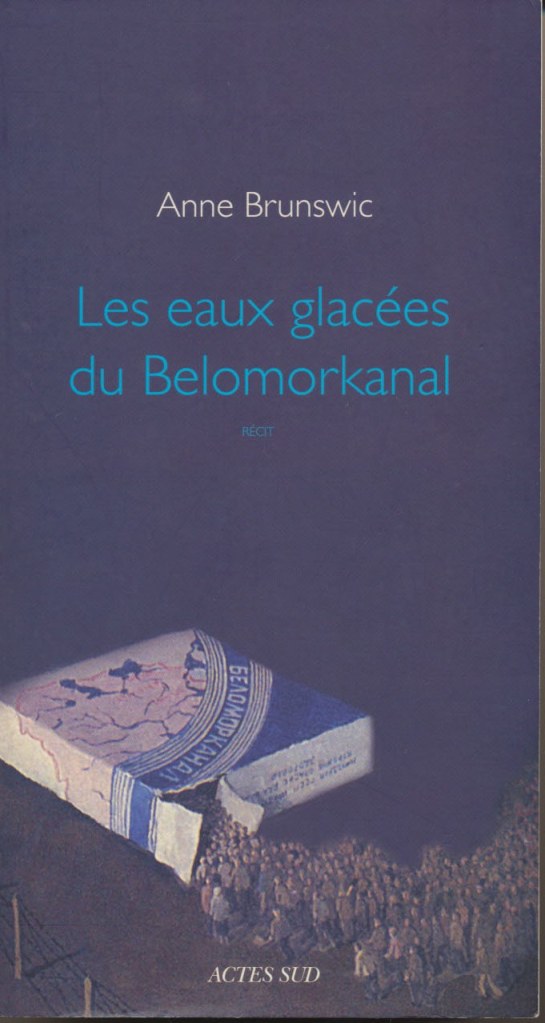
I am currently reading the travel narration “Les eaux glacées du Belomarkanal[2]” written by Anne Brunswic about her voyage along the shores of the “Belomarkanal”. Reading that book, I thought that Russian literature historically blossomed under authoritarian rule – so as we can “witness” more or less in real-time Russia’s way into another authoritarian age – perhaps we will also witness a rebirth of Russian literature and poetry. Perhaps Lyudmila Ulitskaya will be awarded this year’s Nobel Price in Literature. One never knows!
In fact I don’t have any ideas to whom will be awarded this year’s Nobel Prize in literature – but it would be certainly a positive sign for the rebirth of Russian literature if Lyudmila Ulitskaya (or another Russian /Russophone writer/novelist/poet) would be awarded the prize! Tomorrow Thursday 07.10.2021 at 13.00 we will know more!
Bookreference:
Brunswic, Anne (2009): Les eaux glacées du Belomorkanal. Arles, Actes Sud. ISBN 978-2-7427-8214-7
Christophe Neff, Grünstadt 06.10.2021
P.S.:. (07.10.2021 13:05): Finally Abdulrazak Gurnah was awarded with the Nobel Prize in Literature 2021.
[2] As I know the book was never translated into another language. So indeed “les eaux glacées du Belomorkanal (the frozen waters of the Belomorkanal)” would merit a translation into English to get a wider audience.



 paysages