paysages et livres – Landschaften und Bücher – Landscapes and Books

En écrivant ma dernière Blognotice «13.11.2012: Sattar Beheshti – torturé à mort pour avoir osé critiquer le régime de Téhéran sur Facebook », – je me posais la question – et Hossein Derakhshan, il devient quoi ? Il périt comme beaucoup d’autres prisonniers politiques en Iran dans une prison inconnue – avec encore 18,5 d’années de prison devant lui, mais en réalité nous ne savons pas grand-chose sur lui. En me demandant ce qu’est devenu Hossein Derakhshan je suis tombé sur un article de Jillian C. York «The forgotten bloggers (les bloggeurs oubliés)»publié sur Aljazeera, qui nous rappelle le triste destin des bloggeurs emprisonnés (et des autres prisonniers politiques) à Téhéran, à Damas, au Bahreïn. En écrivant mon dernier post, je me suis demandé si cela sert à quelque-chose, si un bloggeur-du-week-end élève sa voix pour un bloggeur torturé à mort dans une prison d’Iran comme ce fut le cas pour Sattar Beheshti – si il essaie de rappeler le destin tragique d’un Bloggeur qui a encore devant lui presque 20 ans de prison, comme c’est actuellement le cas pour Hossein Derakhshan. Oui je crois que cela peut servir à quelque chose – briser le silence et l’oublie– car l’oubli et le silence sont un des pires ennemis des prisonniers politiques. Ou comme l’écrit Jillian C. York «We must continue to help raise their voices to ensure they are not forgotten. (On doit continuer de les aider de à se faire entendre pour s’assurer qu’il ne soit pas oublié) ». Briser le silence pour combattre l’oubli, c’est peut – être la seule chose que nous puissions faire pour Hossein Derakhshan et les autres prisonniers politiques iraniens et dans ce sens je pense que la petite voix d’un bloggeur franco-allemand qui normalement écrit principalement sur les paysages et les livres, parfois aussi sur les relations franco-allemandes, oui je pense qu’elle peut servir à quelque chose.
As I wrote my last Blognotice « Sattar Beheshti – torture to death for having risked criticizing the Tehran regime on Facebook » I asked myself – and Hossein Derakhshan – how is he? At the moment he perishes altogether with other political prisoners in Iran an unknown prison, facing 18, 5 years of prisons – but in fact we don’t know much about him at current time. As I tried to answer this question I discovered an article “The forgotten bloggers” written by Jillian C. York and published on Aljazeera, a text remembering us the sad destiny of bloggers imprisoned (and other political prisoners) in Tehran, Damascus and Bahrain. When I wrote my last Blognotice I asked myself if it benefits for anyone if a week-end blogger rise up his voice to remember a blogger tortured to death as it was the case for Sattar Beheshti – or if he tries to remember the sad destiny of a blogger who has to spent the next twenty years in prison as it is the case of Hossein Derakhshan.
Yes that could be of use, breaking the silence and combatting forgetfulness – because silence and forgetfulness are one of the worst enemies for political prisoners. As Jillian C. York writes “We must continue to help raise their voices to ensure they are not forgotten.”
Breaking the silence and combatting the forgetfulness, that’s perhaps the only thing we can do for Hossein Derakhshan and other political prisoners in Iran (and elsewhere) , – and in this sense I think that the voice of franco-german week-end blogger, who mainly writes on landscapes and books, sometimes also on the French-German relations, could be useful at all!
Christophe Neff, le 18.11.2012
Le mardi 6. Novembre Sattar Beheshti fut torturé à mort à la prison d’Evin pour avoir osé critiquer le régime des mollahs à Téhéran. Cela rappelle un peu Zahra Kazemi – cette photographe irano -canadienne morte des suites des tortures infligées à la prison d’Evin en juillet 2003. Zahra Kazemi avait osé photographier les familles de détenus de la prison d’Evin qui manifestaient devant ce centre de torture qui est la prison d’Evin.
Il y avait dernièrement dans le Monde un éditorial intitulé – N’oublions pas la dissidence iranienne – qui nous a rappelé que le parlement européen avait décerné à Nasrin Sotoudeh et Jafar Panahi le prix Sakharov 2012.
En 2009 pendant que le régime de Téhéran écrasait les hommes et les femmes du „printemps iranien“ de 2009 – j’avais écrit dans paysages – « et ouvrons quant à nous nos portes quand ils en auront besoin ». Ce peut être la seule chose que nous puissions faire pour ces courageux hommes et femmes qui osent faire face à la barbarie du régime de Téhéran et qui, pour une grande partie, croupissent à Evin ou dans des autres prisons: ne pas les oublier et si par chance ils auront la possibilité de quitter les prisons iraniennes vivants, de quitter l’Iran, de les accueillir chez nous, – en France, aux Etats – Unis, etc. dans tous les pays où les mots « liberté & démocratie » ne sont pas de vaines paroles. Le 6 Novembre 2012 un homme est mort sous la torture simplement parce qu’il avait osé critiquer sur Facebook le régime de Téhéran …. Il se nommait Sattar Beheshti : ne l’oublions pas!
On Tuesday the 6 November Sattar Beheshti was tortured to death in the Evin prison for having risked criticizing the Mullah regime of Tehran on Facebook. It’s a perhaps similar to the case of the irano -Canadian photographer Zahra Kazemi who died after having been tortured heavily in the Evin prison. Zahra Kazemi risked taking pictures of protesting family members of Evin prisons political prisoners.
Some days ago the French newspaper Le Monde published an editorial “N’oublions pas la dissidence iranienne (Do not forget the Tehran dissidents)” an editorial which remembers us the current political situation in Iran and the fact that two dissidents, Nasrin Sotoudeh and Jafar Panahi have been awarded with the Sakharov price 2012 by the European parliament. In 2009 while the Tehran regime overruns brutally the Iranian spring I wrote in paysages “«we should open our doors when they will be knocking and ask for our help». Do not forget them – perhaps it’s the only think we could do for the courageous men and women who face the barbaric regime of Tehran. Most of them are currently suffering in Evin or other Iranian prisons, – and if by chance they could leave prison alive , leave the Iran, provide them a safe haven – in France, the U.S.A., and all other countries where liberty and democracy are not only hot air. On November the 6.2012 a man has been tortured to death for having risked criticizing the Tehran regime on Facebook … his name was Sattar Beheshti – we should not forget him!
Sources:
Deghan, Saeed Kamali (2012): Iran accused of torturing blogger to death – Sattar Beheshti’s family told of his death in prison a week after he was arrested for criticising Iran on Facebook. The Guardian, Thursday 8 November 2012 18.03 GMT.
Le Monde/Le Monde.fr (2012): Éditorial 28.10.2012 – N’oublions pas la dissidence iranienne.
Reza, Assal (2012): Un blogueur critique du régime meurt en prison sous la torture. Nouvelles d’Iran – un blog de la rédaction le Monde.
Christophe Neff, le 13.11.2012
Daybreak in Grünstadt: 7. November 2012, 5.50 am. local time, raindrops were falling on the roofs of a sleepy German town. Some minutes later I turned my notebook on to get news from the results of presidential election in the U.S. The first info I got was an alert message by email from le Monde.fr – sent by le Monde.fr at 5.21 – “ “Barack Obama réélu président des Etats-Unis (Barack Obama reelected as President of the United Staates) . At the same moment my wife shouted, – Barack Obama wiedergewählt (Barack Obama reelected) – it was six a clock in the morning – she heard the message in the regional radio news.
At 6.22 am. I received an electronic message from U.S., from a former schoolmate now living in California “looks like Obama won”. At 6.30 arrived the New York Times Alarm – “Breaking News Alert – The New York Times Wednesday, November 7, 2012 — 12:13 AM EST Breaking News: President Obama Wins Re-election, The New York Times Projects”. At 7.01 I read the Le monde.fr alert messages announcing Mitt Romney conceded (Mitt Romney reconnaît sa défaite face à Barack Obama) – and got the same info’s on the NYT live coverage.
At 7.15 am. I mailed back to California “Good Night in California, – ich freue mich für Amerika, – I feel glad for the U.S.!” In Grünstadt the black colors of night changed to diming grey daylight, and it was still raining. The projection of the victory of Barack Obama done in Blognotice 05.11.2012, – had become reality, – but the reelection was much more impressive than I projected it in paysages – because I thought (and wrote) that it could very narrow – similar as the reelection of Gerhard Schröder in 2002 as Chancelor in Germany after the Elbhochwasser . But the political impact of the Hurricane Sandy can’t be compared to situation in Germany in 2002 following the Elbhochwasser, – after all I have read the political impact of the Hurricane Sandy on Obamas Victory seemed to have been minimal – but without the Elbhochwasser Gerhard Schröder would have had enormous difficulties to be reelected as Chancellor . Being sure that Barack Obama was reelected I also remembered my souvenirs of the first election of Barack Obama four years ago. I had to work in Tunis in November 2008 and I followed the historical moment of Barak Obama election in French TV and on CNN. It was an unbelievable atmosphere in Tunisia at that time. I remember a rainy November week in Tunis and la Marsa – on one hand a beginning “fin de règne” ambience in Tunisia – and on the other hand – the United States people for the first time elected an Afro-American to hold the presidential office. Now four years later we know that this November 2008 election of Barack Obama was not an historical accident.
At about 7.50 am. I started my car ride to Office in Karlsruhe, – and it was still raining. Some hours later I learned that Jérôme Ferrari had won the 2012 Prix Goncourt for his novel “Le Sermon sur la chute de Rome” („The Sermon on the Fall of Rome“). So unfortunately the second forecast in paysages Blognotice 05.11.2012 for the Prix Goncourt winner in 2012 was not as good as the projection for the U.S. presidential election. Neither «La vérité sur l’affaire Harry Quebert » (Joël Dicker) nor « Lame de fond » ( Linda Lê) won the Prix Goncourt. Following Pierre Assouline in the Republique des Livres the novel of the Swiss-French writer Joel Dicker is a great American novel describing the 2008 electoral America. A great American novel written in French by a Swiss-French author – this sounds very strange. I have not read the book, but after all what Pierre Assouline wrote about the novel (see here; in French) it would merit a translation into English.
On that last Wednesday morning I also read in our local News Paper, die Rheinpfalz, in an article signed Dagmar Gilcher (Gilcher, D. 2012: Aber die Bilder bleiben) that the novel “L’Art français de la guerre” (Alexis Jenny), the Prix Goncourt winner 2011, has now been translated into German. “Die französische Kunst des Krieges” is the German title of the war novel written by Alexis Jenny . I have read the book in July 2012 and I think it was one of the best French novels I read in the last years. Of course this book would also merit an English translation. The German translation (translator = Uli Wittmann) was released in October 2012 on the German Book market. L’Art français de la Guerre („The French art of war“) immerges deeply into the recent military past of France – and in that recent military past France had to suffer hard in Indochina and Algeria. In Indochina – as did the U.S. forces some years later what now was called Vietnam. The name of the region had changed, – but the place, the geography remained unchanged – Vietnam (and Laos & Cambodia). For both, the French colonial troupes in Indochina and the US-Forces in Vietnam it was a terrible experience – a war in foreign land. Indochina – or as we call it now – Vietnam – confronted the French – and later the U.S. Soldiers with a strange and unfamiliar geography, and an alien people – far away from European – French or U.S. American culture. A very detailed critic of the “L’Art français de la guerre” can be read in “Le grand art si français d’Alexis Jenni (in French)” published in the Pierre Assouline book blog la Republique des livres in August 2011. It sounds strange that this book has not been translated into English, – it is an impressive novel which describes us how war scares over our cultural heritage and interior landscapes – I am sure that the story of Victorien Salagon would find a large audience in the English-speaking world, particularly in the U.S.A.
The morning of the Wednesday 7.11.2012 was a grey November morning in Southwest Germany. All over the morning we heard the rain falling on the autumn leaves. Now four days later as I write down this blognotice it’s still raining. Yesterday we have had some hours of sun shine, – but except this little time of sunshine – I have the feeling that the week of the reelection of Barak Obama for four more years – was a very rainy week – as it was in Tunis in November 2008.
Sources:
Gilcher, Dagmar (2012): Aber die Bilder bleiben. „Die französische Kunst des Krieges“: Alexis Jenny gefeiertes Romandebüt ist jetzt auf Deutsch erschienen. In: Die Rheinpfalz, Nr. 259, Kultur, Mittwoch, 7 November 2012.
Christophe Neff, 10. November 2012
In some hours, at 13.00 Stockholm time, the winner of this year Nobel Prize in Literature will be announced. As every year, paysages (see here: 1, 2, 3 ) tries to forecast the winner, or authors which seem to have good chances to get the Nobel Prize in Literature. Two days ago M.A. Orthofer has published a list of potential winners in the Literary Saloon. The Ladbrokes odds currently put Haruki Murakami as a potential winner for the price. My personal favorites for this year Nobel Prize in Literature are Haruki Murakami, Ngũgĩ wa Thiong’o, Assia Djebar, Mo Yan and Péter Nádas. Perhaps Philip Roth has also some chances to get the price, – recently Alain Finkielkraut has published a review of Roth work “Malheur et châtiment. „Némésis“, Philip Roth in Le Monde des Livres, – reading this review, I thought maybe this year, – Roth perhaps will get the price. If I would have the chance to choose the Nobel Prize in Literature, I would choose Ali Ahmad Said Esber (Adonis)! I consider him as one of the greatest living poets – his work is well known in the francophone and Arabic world. The poetry and work of Adonis could also be considered as symbol for liberty, freedom and humanity in the Arabic World.
In some hours we will know the happy winner of Nobel Prize in Literature 2012.
Christophe Neff, le 11.10.2012
P.S.: (11.10.2012; 13.05) Mo Yan has been awarded the Nobel Price in Literature 2012.
 ClustrMaps is a hit counter map widget which allows showing the locations of the visitors of one specific site in a map. Geographer by education, I was interested to know, where the visitors of “Paysages” come from, so I installed the widget on 7 of April 2011. And since this date its running, providing me and the visitors of paysages nice maps with yellow and red dots. In one year Clustrmaps counted about 13877 readers visiting paysages. Most of the visitors of paysages come from France, followed by visitors from Germany and
  Tunisia. About more than 80 % of the visitors come from France, Germany, Tunisia, USA & Switzerland (Details see Tab 1.). The fact that a large part of the visitors came from France is not surprising, paysages is a francophone Blog, mainly written in French, a blog written mostly for readers in the “francophone world”. Some articles are written in German, and very rarely paysages provides “posts” in English, – in fact this article is the tenth post written in English. To finish this blogostatistique – the mostly visited article – (as told by the wordpress – Le Monde dashboard) is – 1949 – l‘incendie meurtrier dans la Forêt des Landes. I have also written an English version of this post called “The Fatal Forest Fire – remembering the “1949 Mega fire” in the „Forêt des Landes” (South West France)” but this article has not got the audience of the “incendie meurtrier”, this perhaps due to the fact that the “drama of the 19 août 1949” is still present in the collective memory of France, – mainly in South West France. Concerning posts written in German, it seems that “Sturm Xynthia : Blick von der Unterhaardt auf La Faute-sur-Mer, L’Aiguillon und Port Leucate” and “Das Biafrakind” have got a broader audience. Currently since the beginning of paysages – in May 2009 (first English article published on 29 of May 2009) – paysages received 76,477 visitors.
Tab. 1: The geographical provenance of visitors of paysages from 7.4.2011 – 7.4.2012 (source Clustrmaps 7.4.2012)
| Country | Visitors absolute | Visitors % |
| France |
6450 |
46,47% |
| Germany |
3003 |
21,64% |
| Tunisia |
765 |
5,51% |
| USA |
644 |
4,64% |
| Switzerland |
504 |
3,63% |
| Belgium |
477 |
3,43% |
| Canada |
338 |
2,79% |
| Austria |
160 |
1,15% |
| Algeria |
142 |
1,02% |
| Netherlands |
110 |
0,79% |
| total |
91,07% |
Pictures = screenshots from paysages-clustrmaps 7.4.2012
Christophe Neff, 16.4.2012
There has been a coup d’état in Niamey, the new strong man in Niger seems to be the army major Adamou Harouna. President Mamadou Tandja is hold in captivity by the rebels.
Is this the end of the Nigerien constitutional crisis convulsing Niger since August 2010? Difficult to judge now, – perhaps the situation will improve, perhaps the situation will worse. Nobody knows.
This is the fourth coup d‘ Etat since 40 years in Niger. Niger is one the world’s least-developed nations, perhaps one of the poorest African states. But Niger is still a state. A state with some financially rewarding resources like Uranium. But also a state where natural resource depletation, growing demographic pressures, ecosystem degradation will enormously stress every form of government.
Finishing the short posting with the question – how long will the news of the Coup d’état in Niamey take to reach the world (outside the francophone world) ( BBC news has posted this report „Niger leader Mamadou Tandja ‚held by soldiers‘ „ ), when will the news arrive in Germany? Is anybody in Germany concerned by political struggle in Niger? Perhaps some motor-bike tourists searching the famous „Arbre du Ténéré„? Perhaps?
P.S. I (19.2.2010 8:40): The eastern Sahel , Niger included, is facing a new hunger crisis – and perhaps this should also be taken into consideration in our analysis of the current political process in Niger.
P.S. II (19.2.2010 11:40): The new strong men seems to be chef d‘ escadron (major) Salou Djibo. He heads the Supreme Council for the Restoration of Democracy (French: Conseil suprême pour la Restauration de la Démocratie , or CSRD).
P.S. III (19.2.2010 11:50): At 11:40 19.2.2010 the SPON published an article called „Putsch – Militär übernimmt die Macht in Niger“ – describing the coup and analyzing the actual political situation in Niger.
When I was writing Balade d’été sur le Grünstadter Berg (19.7.2009) and linking „panicaut champetre „(the French word for field Ernygium) to wikipedia.fr – I had also a look to the English article on Wikipedia.en describing field eryngium . About 70- 80 % of the article was wrong, – as for example „A member of the carrot family“ – (Eryngium campestre is member of the Apiacea) – and the editing of the wrong family affiliation went back to 15. March 2007 (see revision history). I corrected the sentence, and linked the article to the article describing Eryngium campestre on webpage’s of the Botanical Society of the British Isle and the distribution map on telabotanica showing the distribution of the plant in continental France. I have not corrected the sentence concerning the gall fly, but I think that the celery fly (Acidia heraclei = Philophylla heraclei = Euleia heraclei) should be better on in the article concerning the celery (Apium graveolens). But you will not find anything concerning the celery fly in the celery articles, neither in en, de, fr. This shows clearly the problem of the reliableness of articles concerning traditional naturalist or botany articles on wikipedia. This is only one example; I guess I would find many other examples to demonstrate the problem.
The other problem is that many articles of traditional naturalist interest (botany, physical geography etc. ) are simply missing – as I wrote in the Balade d’été sur le Grünstadter Berg (19.7.2009) no article in Wikipedia.fr about the Zinnkoepfle, which is not only a very interesting naturalistic site but also à notable french „Grand Cru“ (AOC Alsace Grand Cru Zinnkoepfle) ! Neither nor there is an article about the „Grünstadter Berg“ in Wikipedia.de. Noting that the „Grünstadter Berg“ would also merit an English Wikipedia article – because it was during the cold war an important U.S. Missile Basis, – (the 887th Tactical Missile Squadron was based on the Grünstadter Berg ). I think most people in Grünstadt have forgotten the importance which the Grünstadter Berg had during the „cold war“ – or perhaps never known – or never wanted to know
I am not only critizeing Wikipedia – sometimes I’ll try to contribute to .de ,.fr , .en , to improve articles, sometimes even create new one. But not too much on topics where a I have a professional competence – writing on Wikipedia is not very interesting – its not valorizationing scientific competence – that’s the reason why I never intervened in Article Feuer (Umweltfaktor) – the article about fire ecology in the German Wikipedia – which in my opinion is a very good example for a bad article, an article which would need in-depth clean-up. Unlike the German fireecology article the English fireecology articel seems to be very well done, accurate citation of sources etc, – perhaps a little bit to much focused on the U.S. – because we have also forestfires outside the U.S. (and also fireecologist outside the U.S.) – but all in all a good introduction into Fire ecology.
Concerning the „Grünstadter Berg“, perhaps in some days or weeks, if until then, not some other has started an article, I will write a stub for Wikipedia.de. But I prefer to collect material for a regional geography paper presenting the „Grünstadter Berg“ and to submit to a regional geography or naturalistic journal as for example Pollichia, than to write a stub for Wikipedia.
Concerning the Zinnkoeple the French botanist Emil Issler (1951, 1975) has published some papers about the Zinnkoepfle. But even Emil Issler, the French botanist who has done so much for the research of flora & vegetation of the Vosges and the Alsatian plain – he is unknown in the French Wikipedia – and in the other wikis of course too. For (germanreading) readers more interested in a new approach of the Zinnkoepfle and the vallée noble, the can read the pages 48- 51 in my MEDGROW (Neff 2000), – the book version of my PHD-Thesis, but most of the chapter is dedicated to the „Cedrus atlanitca“ (Atlas cedar) experimental plantations done by French foresters in the 1960 not far away from the „Zinnkoepfle“ – in the „forêt du Osenbühr“. And this „Cedrus atlantica“ site, where Cedrus has begun to regenerate without any human intervention, would also merit a botanical & dendroecological revisitation by myself or colleagues – because we could win some interesting findings for global change research and adaption of Mediterranean forest trees in Middle-European forestry, – but this of course has nothing to do with Wikipedia.
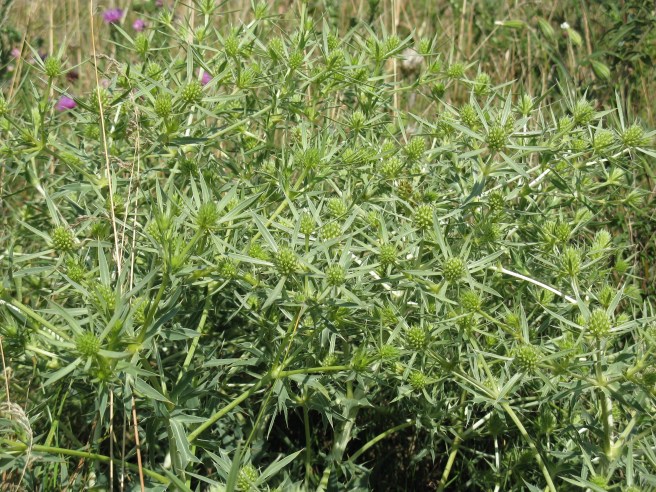
Field eryngium (Eryngium campestris) on xérothermique subméditerranéen grassland on the Grünstadter Berg (Photo C.Neff 19.7.2009 (Canon Powershot A720 IS)).
Literature cited:
Issler, E. (1951): Trockenrasen – und Trockenwaldgesellschaften der oberelsässischen Niederterrasse und ihre Beziehung zu denjenigen der Kalkhügel und der Silikatberge des Osthanges der Vogesen. In: Berichte der Schweizerischen Botanischen Gesellschaft, p. 664- 659.
Issler, E. (1975): Forêts et garides de la plaine haut-rhinoise. In : Saison d‘ Alsace, 61-62, p.94-113.
Neff, C. (2000): MEDGROW – Vegetationsdynamik und Kulturlandschaftswandel im Mittelmeerraum. Mannheimer Geographische Arbeiten, H. 52, Mannheim (Dissertation/PHD-Thesis). (ISBN 3-923750-80-3)
Christophe Neff, Grünstadt
Le blog paysages est maintenant deux mois en ligne – le début était le 24.5.2009 – et en deux mois de fonctionnement il a eu si les statistique wordpress sont vraiment fiables 2254 visiteurs. En ce qui concerne la fiabilité des données statistiques que l’outil wordpress livre – j’ai mes doutes – mais j’ai crois au moins que l’ordre de grandeurs sont à peu près corrects. Dans le tableau en bas on trouve les cinq articles ayant reçu la plupart de lecteurs dans la période du 24.5- 24.7.2009.
Das Blog paysage ist jetzt zwei Monate online – der Beginn war am 24.5.2009 – und nun nach 2 Monaten Dauer hatte das Blog, soweit man den wordpress Statistik glauben mag 2254 Besucher. Was die Verlässlichkeit der von wordpress ausgeben Besucherzahlen angeht habe ich zwar meine Zweifel – aber die Größenordnung wird bestimmt stimmen. Anbei unten eine Tabelle mit den im Zeitraum von 24.5- 24.7.2009 fünf meistbesuchtesten Artikeln.
The Blog paysage is now 2 months online – the blog started on the 24.5.2009 – and now after 2 months „operating“ the blog received 2254 visitors. Concerning the reliability of the numbers provided by the wordpress statistic tools I have some doubts – but I think the dimension seem to be correct. The following table presents the 5 most visited (or readed) articles in the period from24.5 to 24.7.2009.
| Article | Pl. | % | Visiteurs/Leser/Visits |
| 1949 l’incendie meurtier dans la Forêt des Landes | 1.) | 17,901 | 404 |
| I. Un blog sur les paysages : un petit début | 2.) | 17,199 | 388 |
| Nachtrag zum Mannemer Dreck | 3.) | 7,371 | 166 |
| Feux de forêts et lectures de paysages | 4.) | 7,125 | 161 |
| Villa Jasmin | 5.) | 6,388 | 144 |
| ∑ | 55,984 |
Christophe Neff, Grünstadt le 25.7.2009
 paysages